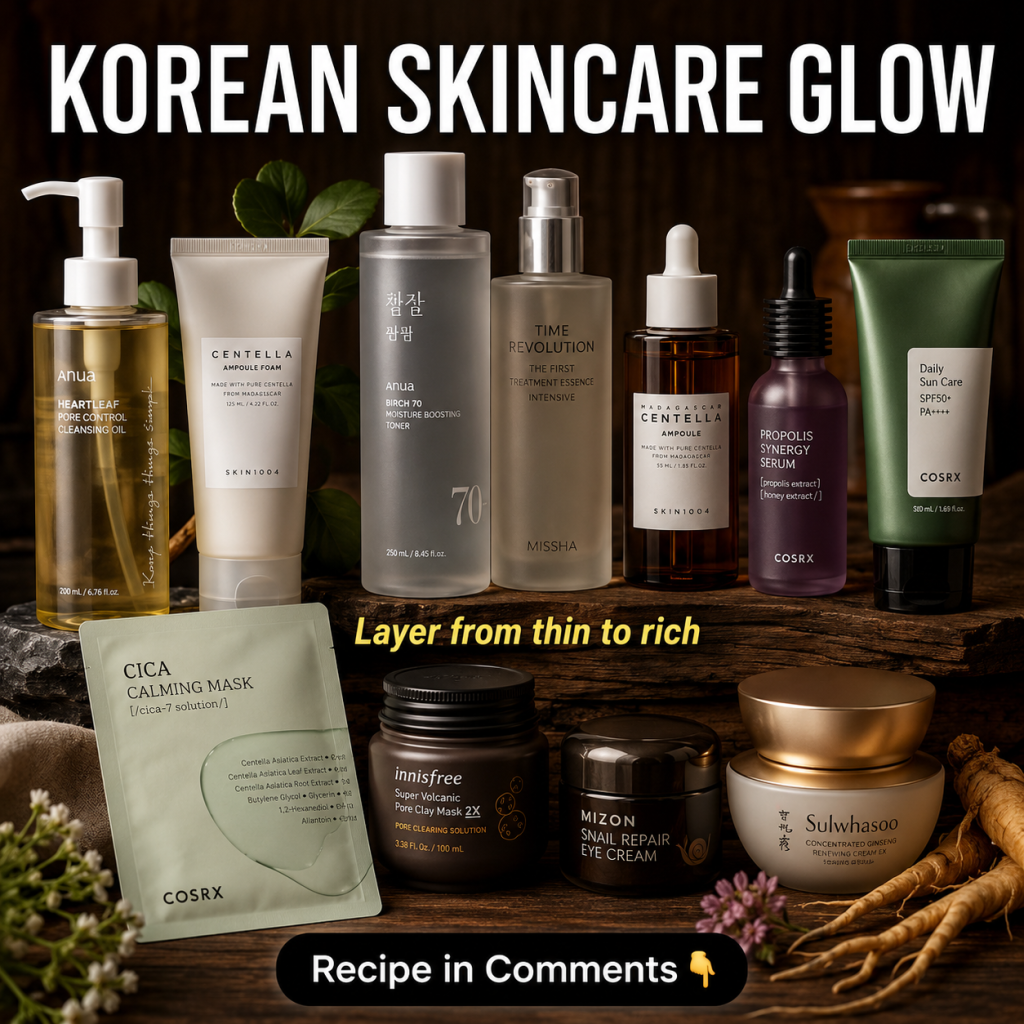
The popular Korean skincare glow is not created by bleaching the skin or using one overnight miracle mask. It comes from a smooth, well-hydrated skin barrier that reflects light evenly. Gentle cleansing, lightweight hydration, careful layering and daily sun protection can make dull skin appear softer, fresher and more luminous. Natural ingredients such as colloidal oatmeal, aloe vera, glycerin, green tea and selected plant oils may support this effect when they are used in suitable quantities for each skin type.
The exact homemade combinations below have not been clinically tested as finished formulas. However, the individual ingredients have published evidence supporting benefits such as moisturization, barrier repair and reduced irritation. Realistic improvements in softness and surface hydration may begin within one to three days. Pigmentation, acne, deep wrinkles and persistent inflammation require longer-term care and may need treatment from a dermatologist.
Remedy 1: For Normal Skin
Green Tea and Aloe Dew-Layer Routine
Ingredients
- 1 teaspoon finely ground colloidal oatmeal
- 2 tablespoons freshly brewed and cooled green tea
- 1 teaspoon pure, decolorized inner-leaf aloe vera gel
- 2 drops vegetable glycerin
- 1 drop high-linoleic sunflower seed oil
Scientific Working of the Ingredients
Colloidal oatmeal contains soothing compounds known as avenanthramides and can help improve dryness, roughness and barrier function. Green tea supplies antioxidant polyphenols, although freshly brewed tea is milder and less standardized than the extracts used in clinical formulations. Aloe vera acts mainly as a humectant, helping the upper skin layers retain water. Glycerin attracts water into the outermost skin layer, while sunflower seed oil provides linoleic acid and helps slow moisture loss. (PubMed)
Procedure
Mix the oatmeal with one tablespoon of green tea to make a runny cleansing paste. Massage it over damp skin for 20 seconds without scrubbing, then rinse. Pat the remaining green tea over the face. Mix the aloe gel with glycerin and spread a very thin layer over slightly damp skin. Finish by pressing one drop of sunflower oil over the cheeks and forehead.
How Often to Apply
Use once each evening for five days. Prepare the mixture freshly every time and discard leftovers.
Initial Results
Within one to three days, normal skin may feel softer, less tight and slightly more luminous because of improved surface hydration. This routine will not permanently lighten the complexion or erase wrinkles.
Remedy 2: For Combination Skin
Zone-Balancing Honey and Jojoba Routine
Ingredients
- 1 teaspoon colloidal oatmeal
- 2 tablespoons cooled green tea
- ½ teaspoon plain honey
- 1 teaspoon pure aloe vera gel
- 1 drop vegetable glycerin
- 1 drop pure jojoba oil
Scientific Working of the Ingredients
Combination skin requires hydration without coating the entire face with heavy oil. Oatmeal gently cleanses while supporting the barrier. Aloe and glycerin supply water-binding hydration. Honey has humectant, antioxidant and antimicrobial properties, although its strongest clinical evidence relates to medical wound care rather than cosmetic brightening or acne treatment. Jojoba is technically a liquid wax rich in wax esters. It works as a lightweight emollient, but evidence for homemade jojoba routines is more limited than evidence for formulated moisturizers. (PMC)
Procedure
Cleanse with oatmeal mixed with one tablespoon of green tea. Combine honey with the remaining tea and apply it only to dull or dry areas, avoiding actively inflamed pimples. Leave it on for five minutes and rinse. Mix aloe with one drop of glycerin and apply all over the face. Press one drop of jojoba oil only onto dry cheeks or flaky areas, not across the oily T-zone.
How Often to Apply
Use on alternate evenings for five days. The aloe layer may be used daily if it causes no irritation.
Initial Results
Dry sections may appear smoother within two or three days, while the forehead and nose should feel hydrated without becoming excessively greasy.
Remedy 3: For Oily Skin
Cooling Green Tea and Oat Hydration Mask
Ingredients
- 1 tablespoon colloidal oatmeal
- 2 tablespoons strong, cooled green tea
- 1 teaspoon pure aloe vera gel
- ¼ teaspoon honey
- 1 drop vegetable glycerin
Scientific Working of the Ingredients
Oily skin can still become dehydrated, especially after harsh cleansing. When surface water is depleted, skin may look rough even when it produces plenty of sebum. Colloidal oatmeal helps cleanse without aggressive stripping. Green tea polyphenols have antioxidant and anti-inflammatory activity, and some formulated topical green-tea studies have reported reductions in sebum. Aloe and a very small amount of glycerin add lightweight hydration. Honey prevents the mask from drying too rapidly, but it should not be presented as a proven treatment for acne. (PubMed)
Procedure
Combine all ingredients into a smooth, thin paste. Apply a light layer to clean skin, avoiding the eyes and broken pimples. Leave it on for five to eight minutes. Do not allow it to become completely hard or cracked. Rinse with lukewarm water and pat dry. Apply a very thin layer of plain aloe gel afterward.
How Often to Apply
Apply once daily for three days, followed by alternate-day use if the skin remains comfortable.
Initial Results
The skin may feel calmer and less rough within one to three days. Oil production is unlikely to change dramatically in this period, but the face may look fresher because dehydrated patches are reduced.
Remedy 4: For Dry Skin
Oat, Honey and Sunflower Barrier Treatment
Ingredients
- 1 tablespoon colloidal oatmeal
- 1 teaspoon plain honey
- 1 teaspoon pure aloe vera gel
- 2 drops vegetable glycerin
- ¼ teaspoon high-linoleic sunflower seed oil
- 2 drops jojoba oil
Scientific Working of the Ingredients
Dry skin needs three types of support: humectants to attract water, emollients to soften rough spaces between skin cells and oils to reduce moisture loss. Aloe, honey and glycerin provide humectant action. Oatmeal supports the irritated outer barrier, while sunflower and jojoba oils supply an emollient layer. Sunflower oil is preferred over undiluted olive or mustard oil because research suggests that linoleic-acid-rich sunflower oil can support barrier recovery. (PubMed)
Procedure
Mix the oatmeal, honey and aloe. Apply to damp skin for eight minutes, then rinse gently. While the face is still slightly damp, mix glycerin with a fresh teaspoon of aloe and apply a thin layer. Blend the sunflower and jojoba oils in your palm and press them over the driest areas. Never store a mixture containing aloe or water because homemade water-based preparations can become contaminated.
How Often to Apply
Use nightly for five days. Reduce the oil quantity if clogged pores appear.
Initial Results
Flaking and tightness may begin to improve within one to three days. Fine dehydration lines can temporarily appear softer, but established wrinkles require consistent sun protection and longer-term professional skincare.
Remedy 5: For Sensitive Skin
Minimal Oat and Aloe Comfort Layer
Ingredients
- 1 teaspoon colloidal oatmeal
- 2 tablespoons cooled, previously boiled water
- 1 teaspoon pure decolorized aloe gel
- 1 drop vegetable glycerin
- 1 drop high-linoleic sunflower seed oil
Scientific Working of the Ingredients
Sensitive skin benefits from a short ingredient list and controlled exposure. Oatmeal has clinical evidence for reducing dryness and supporting impaired barrier function. Aloe and glycerin can improve hydration, but even natural materials may cause contact reactions. Sunflower oil creates a light emollient layer and supplies barrier-supporting fatty acids. The cooled water acts as a clean mixing vehicle and avoids the dryness that can follow washing with very hot water. (PubMed)
Procedure
Patch-test each active ingredient separately before combining them. Mix oatmeal with water and apply as a cool compress for three minutes without rubbing. Rinse and apply a thin layer of aloe. Add glycerin only after aloe has been tolerated for at least two applications. Use the sunflower oil only on visibly dry areas.
How Often to Apply
Use once daily for three to five days. Stop immediately if burning, swelling, itching or worsening redness develops.
Initial Results
Mild tightness and surface dryness may improve within two or three days. Persistent redness, eczema, swelling or painful skin should not be treated repeatedly with home remedies.
Final Tips for a Lasting Korean Skincare Glow
Apply all skincare from the lightest, most watery layer to the richest layer. Use lukewarm rather than hot water, avoid scrubs and keep bowls, spoons, towels and reusable applicators clean. Never apply lemon juice, baking soda, toothpaste, undiluted essential oils or harsh spice mixtures to the face.
Complete a patch test before using aloe, honey, oats or plant oils. People with oat, bee or botanical allergies should avoid the related ingredient. A broad-spectrum, water-resistant sunscreen with SPF 30 or higher should be the last step every morning because ultraviolet exposure contributes to dark spots, collagen breakdown and premature skin ageing. (American Academy of Dermatology)
Visible hydration may begin within two or three days, but true improvement in uneven pigmentation, acne marks or wrinkles generally takes much longer. Home remedies may soften the appearance of dehydration lines, but they cannot permanently reverse established wrinkles.
Diet Plan for Supporting Healthy, Glowing Skin
Follow this balanced plan for at least four weeks while continuing the suitable skincare routine.
Breakfast: Oatmeal or whole-grain bread with yogurt, eggs or lentils, plus one vitamin-C-rich fruit such as guava, orange, kiwi or strawberries.
Mid-morning: Water with a small handful of unsalted nuts or seeds.
Lunch: Half a plate of vegetables or salad, one quarter whole grains such as brown rice or whole-wheat roti, and one quarter protein such as beans, lentils, fish, chicken, tofu or eggs.
Evening snack: Plain yogurt, fruit or roasted chickpeas instead of sugary drinks and fried snacks.
Dinner: Cooked vegetables with lean protein and a moderate serving of whole grains. Include oily fish when appropriate, or use walnuts, chia seeds and flaxseeds as plant sources of beneficial fats.
Drink according to thirst and increase fluids during heat, illness or exercise. A varied diet containing vegetables, fruits, legumes, whole grains and adequate protein is more reliable than relying on beauty supplements. Vitamin C is especially important for normal collagen production, but excessive supplementation is unnecessary when dietary intake is adequate. (World Health Organization)
Continue the selected remedy for five days to assess tolerance, then use it two or three times weekly if helpful. Consult a doctor or dermatologist if the problem persists for two to four weeks, or sooner if there is severe acne, infection, painful swelling, bleeding, intense itching, rapidly spreading pigmentation or an allergic reaction.
References for the above remedy
- Ilnytska O, et al. “Colloidal Oatmeal Improves Skin Barrier and Moisturization.” PubMed.
https://pubmed.ncbi.nlm.nih.gov/27272074/ - Dal’Belo SE, et al. “Moisturizing Effect of Cosmetic Formulations Containing Aloe Vera Extract.” PubMed.
https://pubmed.ncbi.nlm.nih.gov/17026654/ - Fluhr JW, et al. “Glycerol and the Skin: Holistic Approach to Its Origin and Functions.” PubMed.
https://pubmed.ncbi.nlm.nih.gov/18510666/ - Koch W, et al. “Applications of Tea and Its Active Constituents in Cosmetics.” National Library of Medicine.
https://pmc.ncbi.nlm.nih.gov/articles/PMC6930595/ - Lin TK, et al. “Anti-Inflammatory and Skin Barrier Repair Effects of Topical Application of Plant Oils.” National Library of Medicine.
https://pmc.ncbi.nlm.nih.gov/articles/PMC5796020/ - McLoone P, et al. “Honey: A Therapeutic Agent for Disorders of the Skin.” National Library of Medicine.
https://pmc.ncbi.nlm.nih.gov/articles/PMC5661189/ - Gad HA, et al. “Jojoba Oil: An Updated Comprehensive Review.” National Library of Medicine.
https://pmc.ncbi.nlm.nih.gov/articles/PMC8197201/ - American Academy of Dermatology. “Sunscreen Frequently Asked Questions.”
https://www.aad.org/media/stats-sunscreen - World Health Organization. “Healthy Diet.”
https://www.who.int/news-room/fact-sheets/detail/healthy-diet - National Institutes of Health, Office of Dietary Supplements. “Vitamin C Fact Sheet for Health Professionals.”
https://ods.od.nih.gov/factsheets/VitaminC-HealthProfessional/