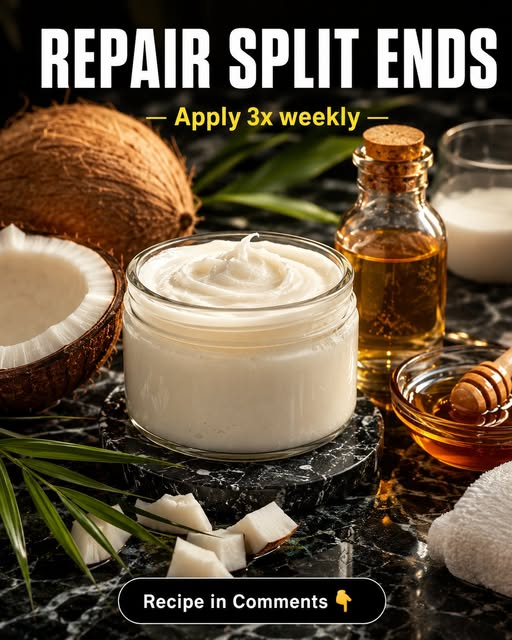
Split ends make hair look dry, frizzy, uneven and difficult to style. They develop when the protective cuticle at the end of a strand becomes worn away, allowing the inner fibres to separate. Repeated bleaching, excessive heat, rough towel drying, tight hairstyles, aggressive brushing and environmental exposure can speed up this damage. Because the visible hair shaft is no longer living tissue, an existing split cannot biologically heal or permanently join itself together. Trimming is the only way to remove it completely. However, natural oils and conditioning masks can temporarily coat frayed ends, reduce friction, improve shine and help prevent the split from travelling farther up the strand. Protein-rich conditioners can also temporarily seal split ends and make hair appear thicker and smoother. (PMC)
The remedies below are designed for different hair types. Their individual ingredients have evidence for reducing protein loss, oxidative damage, dryness or grooming-related breakage, but the complete homemade mixtures have not been tested as clinical formulations. Expect softer, smoother ends within one to three days, while reduced breakage requires several weeks of consistent care.
Remedy 1: Coconut and Argan Smoothing Mask for Normal Hair
Ingredients and Their Scientific Benefits
- Virgin coconut oil – 2 teaspoons: Its lauric-acid-rich structure allows it to enter the hair shaft and reduce protein loss.
- Pure argan oil – 1 teaspoon: Laboratory research shows that pretreatment with argan oil can reduce oxidative damage and protein loss.
- Pure aloe vera gel – 1 tablespoon: Provides a lightweight, water-rich base and improves the spread of the oils.
- Raw honey – 1 teaspoon: Acts as a humectant and prevents the mask from drying too firmly on the hair.
- Unsweetened oat milk – 1 tablespoon: Adds slip and helps the mixture spread evenly over rough ends.
- Cooled boiled water – 1 tablespoon: Produces a lighter consistency that rinses more easily.
How This Remedy Works Scientifically
Coconut oil has stronger evidence for protecting the hair fibre than many other popular kitchen oils. Its relatively low molecular weight and straight fatty-acid structure allow it to penetrate the shaft instead of remaining only on the surface. In controlled laboratory testing, coconut oil reduced protein loss from both damaged and undamaged hair. Argan oil provides additional surface lubrication and has shown protection against oxidative damage caused by processes similar to colouring and bleaching. (PubMed)
Procedure
Mix the aloe, honey, oat milk and water first. Slowly add the coconut and argan oils while stirring. Apply the treatment from the middle of the hair to the ends, concentrating on the final five to eight centimetres. Do not saturate the scalp.
Leave it on for 25–30 minutes. Rinse with lukewarm water and shampoo gently if required. Pat the hair with a soft cotton T-shirt instead of rubbing it.
How Often to Apply
Use three times weekly for four weeks.
Initial Results
The ends may look shinier and feel less rough after the first application. Frizz and tangling may begin improving within two or three days, but visible splits will still require trimming.
Remedy 2: Lightweight Aloe and Grapeseed Treatment for Fine or Oily Hair
Ingredients and Their Scientific Benefits
- Pure aloe vera gel – 2 tablespoons: Creates a light conditioning base without heavily coating fine strands.
- Grapeseed oil – ½ teaspoon: Adds lubrication while feeling lighter than thick butters.
- Virgin coconut oil – ¼ teaspoon: Supplies a small amount of penetrating oil without flattening fine hair.
- Rice starch – 1 teaspoon: Thickens the mixture and absorbs some excess oil.
- Colloidal oatmeal – ½ teaspoon: Helps produce a smooth, non-abrasive paste.
- Vegetable glycerin – ¼ teaspoon: Helps retain moisture around dry, porous ends.
- Cooled boiled water – 1 tablespoon: Keeps the treatment light and easy to rinse.
How This Remedy Works Scientifically
Fine hair needs lubrication, but too much heavy oil can make it limp. The tiny quantity of coconut oil helps reduce protein loss, while grapeseed oil coats the outer fibre and reduces friction during combing. Experimental comparison of botanical oils on human hair found that grapeseed oil produced favourable effects on several measured hair-quality characteristics, although this does not mean it permanently repairs split ends. (PMC)
Procedure
Combine the rice starch and oatmeal. Add the aloe, glycerin and water, followed by both oils. Stir until smooth.
Apply a very thin layer to the ends only. Leave it on for 15–20 minutes, rinse thoroughly and avoid placing additional oil near the roots. Detangle slowly with a wide-tooth comb, beginning at the ends.
How Often to Apply
Apply on alternate days for three applications during the first week, then twice weekly.
Initial Results
Hair may feel less tangled after the first use. The ends may appear smoother within one to three days without becoming excessively greasy.
Remedy 3: Coconut, Shea and Honey Recovery Mask for Dry or Coarse Hair
Ingredients and Their Scientific Benefits
- Virgin coconut oil – 1 tablespoon: Penetrates the hair shaft and reduces washing-related protein loss.
- Plain shea butter – 1 teaspoon: Works as a rich surface emollient for coarse, weathered ends.
- Coconut milk – 2 tablespoons: Creates a creamy base containing water and natural lipids.
- Raw honey – 1 teaspoon: Helps the mixture hold moisture around dry fibres.
- Pure aloe vera gel – 1 tablespoon: Balances the heavy oils with lightweight hydration.
- Colloidal oatmeal – 1 teaspoon: Thickens the mask without using harsh or grainy scrubs.
How This Remedy Works Scientifically
Dry, coarse hair usually has greater surface friction and may lose moisture quickly after washing. Coconut oil enters damaged areas of the fibre and forms a barrier that reduces further protein loss. Shea butter mainly remains on the outside, where it softens the surface and improves slip. Shea-derived ingredients are widely used as conditioning agents, although evidence for directly repairing split ends is limited. (PubMed)
Procedure
Soften the shea butter and coconut oil between the palms or over gently warmed water. Do not overheat them. Mix in the coconut milk, honey, aloe and oatmeal.
Apply generously to the lengths and ends. Cover the hair with a clean shower cap and leave the mask on for 30–40 minutes. Shampoo gently and follow with careful detangling.
How Often to Apply
Use three times weekly for the first two weeks, then once or twice weekly.
Initial Results
Very dry ends may feel softer after one treatment. Shine and flexibility may improve within two to three days, while reduced snapping usually takes several weeks.
Remedy 4: Flaxseed and Jojoba Slip Mask for Curly or Coily Hair
Ingredients and Their Scientific Benefits
- Fresh flaxseed gel – 2 tablespoons: Its natural mucilage creates slip and helps curls move past one another with less friction.
- Virgin coconut oil – 1 teaspoon: Reduces protein loss and improves protection during washing.
- Jojoba oil – 1 teaspoon: A lightweight wax ester that coats strands and improves manageability.
- Pure aloe vera gel – 1 tablespoon: Provides moisture without disturbing the curl pattern excessively.
- Raw honey – ½ teaspoon: Helps the mask remain flexible rather than drying hard.
- Cooled boiled water – 1 tablespoon: Adjusts the consistency for even distribution.
How This Remedy Works Scientifically
Curly and coily hair is especially vulnerable to mechanical breakage because natural bends create points of weakness and make scalp oil less able to reach the ends. Flaxseed gel mainly provides physical slip rather than proven structural repair. Coconut and jojoba oils reduce friction and make detangling easier. Dermatologists recommend conditioning curly hair thoroughly, washing only as needed and detangling in sections while the hair is damp. (American Academy of Dermatology)
Procedure
To prepare flaxseed gel, simmer one tablespoon of whole flaxseeds in one cup of water for five to seven minutes. Strain while warm and allow the gel to cool completely.
Measure two tablespoons of gel and mix in the remaining ingredients. Apply to damp hair in small sections, focusing on the ends. Leave for 25 minutes, rinse and detangle while the hair is still damp.
How Often to Apply
Use two or three times weekly for four weeks. Refrigerate plain flaxseed gel for no more than three days and discard it if its smell or appearance changes.
Initial Results
Curls may feel more slippery and easier to separate after the first treatment. Less tangling and end breakage may be noticed within three to seven days.
Remedy 5: Argan, Coconut and Oat Mask for Bleached or Chemically Treated Hair
Ingredients and Their Scientific Benefits
- Pure argan oil – 1 teaspoon: Helps protect hair proteins from oxidative damage.
- Virgin coconut oil – 1 teaspoon: Penetrates porous areas and reduces protein loss.
- Grapeseed oil – ½ teaspoon: Adds surface lubrication without making the mask excessively heavy.
- Pure aloe vera gel – 1 tablespoon: Creates a soothing, water-based carrier.
- Colloidal oatmeal – 1 teaspoon: Produces a gentle paste suitable for fragile hair.
- Rice starch – 1 teaspoon: Improves coating and makes the mask easier to distribute.
- Cooled boiled water – 1 tablespoon: Adjusts thickness and supports even application.
How This Remedy Works Scientifically
Bleaching and chemical straightening remove protective lipids and damage both the cuticle and inner proteins. Argan oil has demonstrated protection against oxidative hair damage, while penetrating coconut oil can decrease protein loss. The mask can temporarily smooth porous ends, but severely bleached splits cannot be permanently reconstructed at home. (PubMed)
Procedure
Mix the oatmeal, rice starch, aloe and water. Stir in the three oils. Apply only to the lengths and ends, avoiding an irritated scalp.
Leave for 20–30 minutes and rinse with lukewarm water. Do not use a flat iron immediately afterward. Allow the hair to air-dry partially and use the lowest practical heat setting when styling.
How Often to Apply
Apply twice weekly for four to six weeks. Avoid additional bleaching or chemical processing during this recovery period.
Initial Results
Porous ends may feel smoother after the first application. Frizz and dullness may look reduced within two or three days, but badly split sections should be trimmed.
Final Tips to Prevent New Split Ends
Trim above visible splits with sharp hair-cutting scissors. Pulling the split apart or burning the ends can create more damage. Use conditioner after every shampoo and place it mainly on the middle lengths and ends. Leave-in conditioner can further reduce tangling, breakage and split-end formation. (American Academy of Dermatology)
Use a wide-tooth comb and begin at the ends before moving upward. Do not perform “100 brush strokes,” as excessive brushing can produce split ends. Wrap wet hair in a soft T-shirt or microfiber towel instead of rubbing it. Limit straighteners, curling irons and blow-dryers, and use low or medium heat. (American Academy of Dermatology)
Keep treatments mainly on the lengths. Heavy scalp oiling may worsen dandruff or seborrhoeic dermatitis in some people. Avoid raw lemon juice, baking soda, undiluted essential oils and extremely hot oil treatments.
Smoother texture and shine can begin within two to three days. Continue the selected remedy for at least four weeks and maintain gentle hair habits for eight to twelve weeks. Home treatments help prevent additional damage; they do not replace trimming.
Diet Plan for Stronger New Hair
Diet cannot repair the hair that has already split, but balanced nutrition supports healthier hair as it grows from the follicle.
Breakfast: Eggs or unsweetened yoghurt with oatmeal, berries and ground flaxseed.
Mid-morning: Guava, orange or kiwi with water.
Lunch: Lentils, chickpeas, chicken or fish with leafy vegetables and whole-grain rice or roti.
Snack: Almonds, walnuts, pumpkin seeds or roasted chickpeas.
Dinner: Fish, tofu, beans, eggs or lean meat with mixed vegetables.
Weekly focus: Include adequate protein, iron-rich foods, vitamin-C-rich fruits, zinc sources and omega-3 fats. Avoid taking high-dose hair supplements without a confirmed deficiency. A varied diet based on minimally processed foods is more appropriate than relying on one “hair-growth” ingredient. (World Health Organization)
Follow this diet and protective hair routine for at least eight to twelve weeks. See a dermatologist or doctor if breakage begins near the roots, hair suddenly becomes extremely fragile, shedding increases, bald patches appear, or the scalp develops pain, pus, thick scaling or persistent itching. Fatigue, pale skin, weight changes or menstrual problems may also justify medical testing for nutritional, hormonal or thyroid-related conditions.
References for the above remedy
- Rele AS, Mohile RB. Effect of Mineral Oil, Sunflower Oil and Coconut Oil on Prevention of Hair Damage.
https://pubmed.ncbi.nlm.nih.gov/12715094/ - Sharifi N, et al. Argan Oil as a Pretreatment of Human Hair Before Exposure to Oxidative Damage.
https://pubmed.ncbi.nlm.nih.gov/35226791/ - Dias MFRG. Hair Cosmetics: An Overview.
https://pmc.ncbi.nlm.nih.gov/articles/PMC4387693/ - Fernandes C, et al. On Hair Care Physicochemistry: From Structure and Degradation to Novel Biobased Conditioning Agents.
https://pmc.ncbi.nlm.nih.gov/articles/PMC9921463/ - Sureka P, et al. A Method to Measure Oil Penetration into Hair and Correlation to Tensile Strength.
https://pmc.ncbi.nlm.nih.gov/articles/PMC9447460/ - D’Souza P, Rathi SK. Shampoo and Conditioners: What a Dermatologist Should Know.
https://pmc.ncbi.nlm.nih.gov/articles/PMC4458934/ - American Academy of Dermatology Association. How to Stop Damaging Your Hair.
https://www.aad.org/public/diseases/hair-loss/insider/stop-damage - American Academy of Dermatology Association. Tips for Healthy Hair.
https://www.aad.org/public/everyday-care/hair-scalp-care/hair/healthy-hair-tips - American Academy of Dermatology Association. Six Curly Hair Care Tips from Dermatologists.
https://www.aad.org/public/everyday-care/hair-scalp-care/hair/curly-hair-care - Almohanna HM, et al. The Role of Vitamins and Minerals in Hair Loss: A Review.
https://pubmed.ncbi.nlm.nih.gov/30547302/