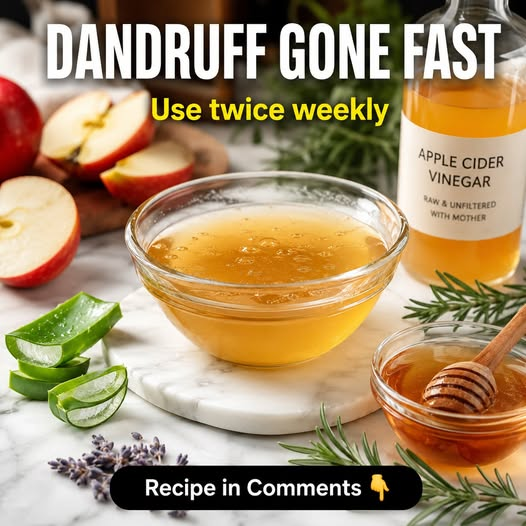
Dandruff causes visible white or grey flakes, itching and scalp discomfort that can affect confidence, particularly when flakes collect on dark hair or clothing. It is commonly linked with accelerated shedding of scalp cells, oil production, irritation and an altered response to Malassezia yeasts that normally live on the scalp. Dandruff is not contagious, but it often returns and may require ongoing control rather than a one-time cure. Natural treatments can sometimes reduce itching, greasiness and loose flakes, but “dandruff gone fast” should not be interpreted as a guaranteed cure within a few days. (Mayo Clinic)
The apple-cider vinegar displayed in the image has deliberately been excluded from the remedies. There is insufficient clinical evidence that homemade vinegar rinses reliably treat dandruff, and vinegar’s acetic acid can irritate or chemically burn the skin when its concentration or contact time is unsuitable. Rosemary and lavender oils have also been excluded because strong clinical evidence for dandruff is lacking, and fragranced essential oils may trigger allergic contact dermatitis. (PubMed)
Choose one remedy according to the condition of your scalp. These formulas are evidence-informed, but the exact homemade mixtures have not been evaluated in clinical trials. Patch-test each preparation behind the ear, avoid broken or bleeding skin and prepare a fresh quantity for every application.
Remedy 1: For a Normal Scalp
Diluted Tea Tree, Aloe and Jojoba Pre-Shampoo Treatment
Ingredients
- 2 teaspoons pure inner-leaf aloe vera gel: Provides lightweight hydration and may calm irritation.
- 2 teaspoons cooled green tea: Supplies antioxidant polyphenols and a water-based treatment base.
- 1 teaspoon jojoba oil: Softens attached flakes and reduces excessive dryness.
- 1 drop tea tree essential oil: Provides a highly diluted source of antifungal terpenes.
- ½ teaspoon colloidal oatmeal: Helps soothe itching and supports the scalp barrier.
- 1 teaspoon boiled and cooled water: Adjusts the mixture to a spreadable consistency.
How the Ingredients Work Scientifically
A randomized clinical trial involving 126 participants found that a professionally manufactured shampoo containing 5% tea tree oil improved dandruff severity by 41% over four weeks, compared with 11% improvement from placebo. Tea tree oil may inhibit organisms associated with dandruff while reducing itching and greasiness. However, a clinical shampoo is carefully formulated and cannot be safely reproduced by simply adding large quantities of essential oil at home. The recipe above therefore uses a much lower concentration to reduce irritation risk, so its effect may be milder than the studied preparation. Aloe and oatmeal provide soothing support rather than directly eliminating dandruff. (PubMed)
Procedure
First mix the tea tree oil thoroughly into the jojoba oil. In a separate bowl, combine the aloe, green tea, oatmeal and water. Add the diluted oil and whisk well. Part the hair and apply a thin layer directly to the scalp rather than coating the hair lengths. Leave it on for 10 minutes, then rinse and wash with a gentle shampoo.
How Often to Apply
Use twice during the first five days, with at least two days between applications. Continue twice weekly for up to four weeks when no irritation occurs.
Initial Results
Itching and greasiness may begin to feel less noticeable within one to three days. Visible flakes may loosen more easily, but substantial improvement generally requires several weeks.
Remedy 2: For a Combination Scalp
Honey, Aloe and Oat Balancing Scalp Mask
Ingredients
- 2 teaspoons raw honey: Provides the principal evidence-supported ingredient.
- 1 teaspoon warm boiled water: Dilutes the honey and improves spreadability.
- 1 teaspoon aloe vera gel: Hydrates dry areas without heavily oiling the roots.
- ½ teaspoon colloidal oatmeal: Helps calm itching and dryness.
- 1 teaspoon cooled green tea: Adds lightweight antioxidant support.
- 2 drops sunflower seed oil: Protects only the dry or tight areas of the scalp.
How the Ingredients Work Scientifically
A small study involving people with chronic dandruff and seborrheic dermatitis tested crude honey diluted with warm water. The mixture was applied every other day, left for approximately three hours and then rinsed. Participants experienced improvement in itching, scaling and lesions, although the study was small and did not use the stronger design expected of a large randomized trial. Honey has antimicrobial, moisture-retaining and anti-inflammatory properties. Aloe and oatmeal may improve comfort, while the tiny amount of sunflower oil is intended only for dry areas. (PubMed)
Procedure
Mix the honey and warm water until smooth. Add the aloe, oatmeal and cooled green tea. Apply the mixture to the entire scalp. Press the sunflower oil only onto visibly dry areas, avoiding greasy roots. Leave the mask on for 20–30 minutes rather than copying the study’s inconvenient three-hour contact time. Rinse thoroughly and shampoo gently.
How Often to Apply
Apply every other day for the first five days, giving three applications. Continue once or twice weekly for another two to three weeks if it helps.
Initial Results
The scalp may feel calmer after the first or second treatment. Loose flakes may wash away more easily within three days, but recurring dandruff is unlikely to disappear permanently.
Remedy 3: For an Oily Scalp
Low-Strength Lemongrass and Aloe Scalp Tonic
Ingredients
- 1 tablespoon aloe vera gel: Creates a non-greasy base.
- 1 tablespoon boiled and cooled water: Dilutes the treatment.
- 1 teaspoon cooled green tea: Helps refresh an oily scalp.
- ½ teaspoon colloidal oatmeal: Reduces the risk of excessive dryness.
- ½ teaspoon jojoba oil: Serves as the essential-oil carrier.
- 1 drop lemongrass essential oil: Provides a very low-strength botanical active.
How the Ingredients Work Scientifically
A randomized, double-blind study evaluated professionally formulated lemongrass hair tonics containing 5%, 10% or 15% essential oil. Participants used the tonic twice daily, and significant reductions in dandruff were observed after seven and fourteen days; the 10% preparation produced the strongest result. Those high concentrations were prepared in a controlled cosmetic base and should not be recreated at home because lemongrass oil can irritate or sensitize the skin. This homemade version uses only one highly diluted drop, meaning it is safer but not equivalent to the clinical formula. (PubMed)
Procedure
Blend the lemongrass oil completely into the jojoba oil. Combine the aloe, water, green tea and oatmeal separately, then whisk in the diluted oil. Apply sparingly to oily scalp areas with clean fingertips. Leave it on for five minutes during the first application. When no reaction occurs, later treatments may remain for up to 10 minutes. Rinse and shampoo.
How Often to Apply
Use twice during the first five days. Never apply it on consecutive days, and never increase the essential-oil quantity.
Initial Results
The scalp may feel fresher and less oily after one or two applications. Reduced flaking is more realistic after one to two weeks, based on the timeframe used in the clinical study.
Remedy 4: For a Dry Scalp
Coconut, Aloe and Oat Flake-Softening Treatment
Ingredients
- 1 teaspoon virgin coconut oil: Softens dry scales and reduces moisture loss.
- 1 tablespoon aloe vera gel: Adds water-based hydration.
- 1 teaspoon colloidal oatmeal: Soothes dry, itchy skin.
- ½ teaspoon honey: Helps retain moisture.
- 1 teaspoon cooled green tea: Makes the mixture easier to distribute.
- 2 drops sunflower seed oil: Supports the skin barrier.
How the Ingredients Work Scientifically
A scalp-microbiome study found that coconut-oil application was associated with changes considered favourable for scalp health, including enrichment of certain beneficial organisms. This does not prove that coconut oil cures dandruff, and heavy oil application can sometimes make greasy seborrheic dermatitis feel worse. It is therefore better suited to genuinely dry, non-oily scalps. Oatmeal, aloe, honey and sunflower oil mainly soften scales and reduce barrier-related discomfort. (PubMed)
Procedure
Warm the coconut oil between clean fingertips without heating it directly. Mix it with the sunflower oil. Combine the aloe, oatmeal, honey and green tea, then stir in the oils. Apply a very thin layer to dry sections of the scalp. Leave it for 15 minutes and shampoo thoroughly so that no oily residue remains.
How Often to Apply
Use twice during five days, then once weekly for up to three weeks. Stop if the scalp becomes greasier or the flakes turn yellow and sticky.
Initial Results
Dry tightness may improve after the first application. Flakes may soften and become easier to remove within one to three days, but this does not mean the underlying condition is cured.
Remedy 5: For a Sensitive Scalp
Fragrance-Free Aloe and Colloidal Oat Compress
Ingredients
- 1 tablespoon boiled and cooled water: Creates a simple, fragrance-free base.
- 1 tablespoon pure aloe vera gel: Supplies gentle hydration.
- 1 teaspoon colloidal oatmeal: Helps relieve itch and irritation.
- ½ teaspoon vegetable glycerin: Attracts and retains water.
- 2 drops sunflower seed oil: Limits moisture loss.
- 1 teaspoon cooled green tea: Provides mild antioxidant support.
How the Ingredients Work Scientifically
Sensitive scalps can worsen when exposed to fragranced oils, acids, harsh scrubs or frequent washing. Colloidal oatmeal has demonstrated anti-inflammatory and itch-relieving activity, while aloe vera was evaluated in a randomized, placebo-controlled trial involving adults with seborrheic dermatitis. These ingredients may reduce discomfort, although they are not as reliably antifungal as established medicated dandruff treatments. (PubMed)
Procedure
Mix all ingredients until smooth. Dip a clean piece of soft cotton cloth into the liquid. Part the hair and press the cloth gently against irritated scalp areas without rubbing or scratching. Leave the treatment on for five minutes, rinse with lukewarm water and pat the hairline dry.
How Often to Apply
Apply once daily for three days. Continue for five days only when no burning, swelling, rash or increased itching develops.
Initial Results
Itching and tightness may begin settling within one to three days. Persistent redness, thick scaling or worsening symptoms require medical assessment rather than repeated home treatment.
Final Tips for Controlling Dandruff
Wash the scalp regularly enough to remove accumulated oil, dead cells and hair-product residue. Apply shampoo to the scalp rather than concentrating it on the hair lengths. Avoid scratching flakes with fingernails because this may create wounds and infection. Keep combs, brushes, pillowcases and towels clean, and limit heavy styling oils on an oily or dandruff-prone scalp. (American Academy of Dermatology)
Natural remedies are not substitutes for treatments with established antifungal activity. When home care is insufficient, dandruff shampoos containing agents such as ketoconazole, selenium sulfide, zinc pyrithione, salicylic acid or coal tar are commonly used according to label directions and scalp condition. Some shampoos must remain on the scalp for several minutes before rinsing. (American Academy of Dermatology)
Do not apply undiluted tea tree, lemongrass, rosemary or lavender oil. Avoid apple-cider vinegar, lemon juice, baking soda and garlic because irritation may worsen itching, flaking and inflammation. Patch-test every natural mixture and stop using it immediately if the scalp burns.
Diet Plan for Supporting Scalp Health
No specific diet has been proven to cure dandruff. Research examining nutrition and seborrheic dermatitis remains limited and inconsistent, so restrictive detox plans and high-dose supplements should be avoided. A balanced eating pattern can support normal skin function without promising a direct cure. (PMC)
For breakfast, choose eggs, unsweetened yogurt, oats or whole-grain bread with fruit. At lunch, eat fish, chicken, lentils, chickpeas or beans with vegetables and brown rice or whole-grain bread. Select almonds, walnuts, pumpkin seeds, sunflower seeds or fruit for a snack. Dinner should include vegetables and a source of protein such as fish, chicken, tofu, lentils or beans.
Include foods naturally providing zinc, B vitamins, protein and beneficial fats, but do not take large doses of biotin, selenium, zinc or vitamin A unless a healthcare professional confirms a deficiency. Excessive supplementation can create imbalances and may contribute to other health or hair problems. (PMC)
Try the chosen home remedy for three to five days and assess irritation, itching and flaking. Continue a well-tolerated treatment for two to four weeks because dandruff rarely disappears after one application. See a doctor or dermatologist if the problem persists, repeatedly returns, causes severe redness, pain, crusting, bleeding, pus, patchy hair loss or thick silver-coloured scales. These symptoms may indicate seborrheic dermatitis, psoriasis, eczema, contact allergy or a fungal scalp infection requiring a different treatment. (American Academy of Dermatology)
References for the above remedy
- Satchell AC, et al. “Treatment of Dandruff with 5% Tea Tree Oil Shampoo.”
https://pubmed.ncbi.nlm.nih.gov/12451368/ - Al-Waili NS. “Therapeutic and Prophylactic Effects of Crude Honey on Chronic Seborrheic Dermatitis and Dandruff.”
https://pubmed.ncbi.nlm.nih.gov/11485891/ - Chaisripipat W, Lourith N, Kanlayavattanakul M. “Anti-Dandruff Hair Tonic Containing Lemongrass Oil.”
https://pubmed.ncbi.nlm.nih.gov/26566122/ - Vardy DA, et al. “A Double-Blind, Placebo-Controlled Trial of an Aloe Vera Emulsion in the Treatment of Seborrheic Dermatitis.”
https://www.tandfonline.com/doi/abs/10.3109/09546639909055904 - Saxena R, et al. “Longitudinal Study of the Scalp Microbiome Suggests Coconut Oil to Enrich Healthy Scalp Commensals.”
https://pubmed.ncbi.nlm.nih.gov/33790324/ - American Academy of Dermatology Association. “How to Treat Dandruff.”
https://www.aad.org/public/everyday-care/hair-scalp-care/scalp/treat-dandruff - National Center for Complementary and Integrative Health. “Tea Tree Oil: Usefulness and Safety.”
https://www.nccih.nih.gov/health/tea-tree-oil - Borda LJ, Wikramanayake TC. “Seborrheic Dermatitis and Dandruff: A Comprehensive Review.”
https://pmc.ncbi.nlm.nih.gov/articles/PMC4852869/ - Feldstein S, et al. “Chemical Burn from Vinegar Following an Internet-Based Protocol.”
https://pubmed.ncbi.nlm.nih.gov/26155328/ - Woolhiser E, et al. “Nutrition, Obesity, and Seborrheic Dermatitis: A Systematic Review.”
https://pmc.ncbi.nlm.nih.gov/articles/PMC11333864/