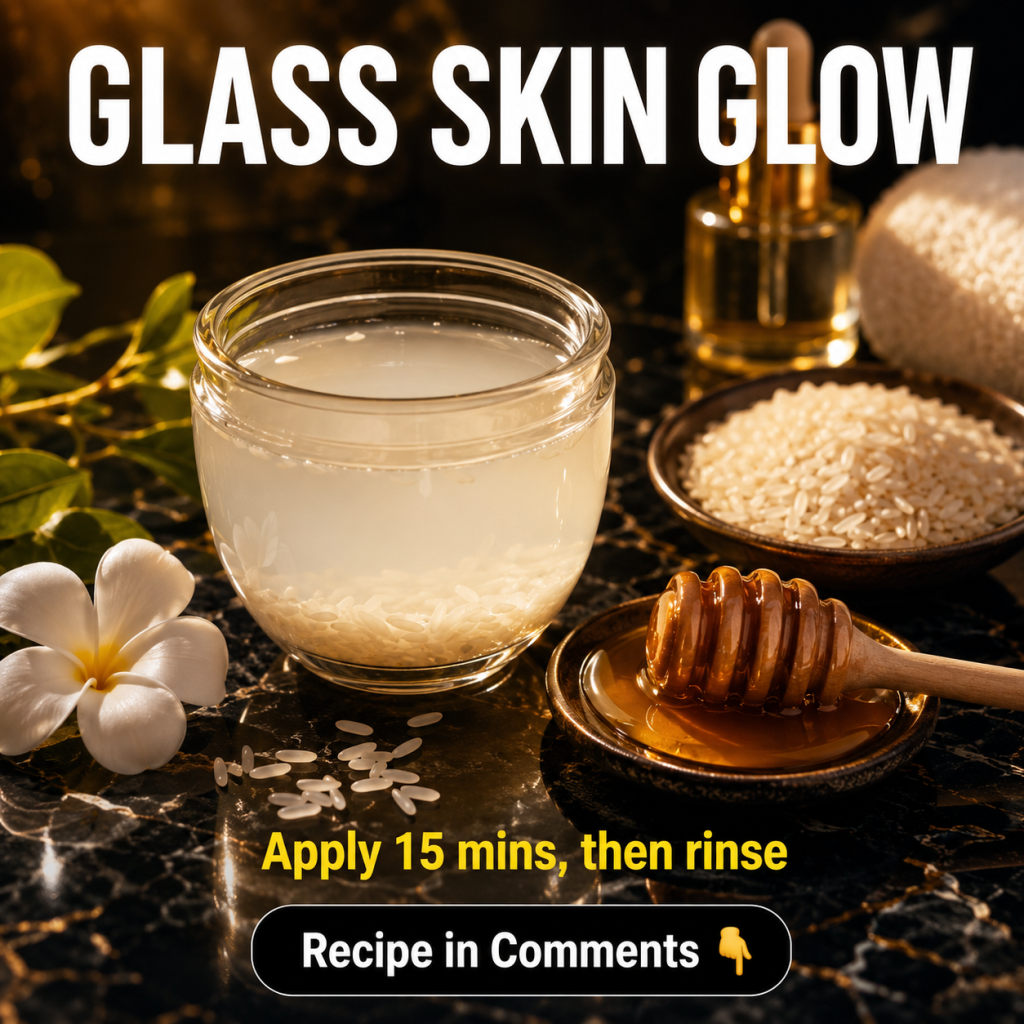
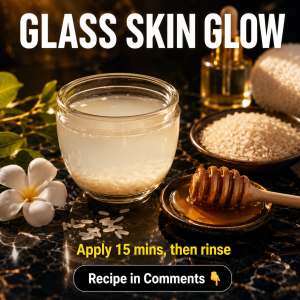
“Glass skin” describes a complexion that appears smooth, evenly hydrated, clear and naturally reflective. The rice-water-and-honey mask shown in the image may temporarily soften rough surface cells and give the face a fresher appearance, but it cannot permanently change pore size, erase pigmentation or remove wrinkles in 15 minutes. Human research has found that rice starch can support recovery of a damaged skin barrier, while specially formulated rice-bran extracts may improve hydration and roughness over several weeks. These studies did not test ordinary homemade rice water, so the following remedies should be viewed as gentle supportive care rather than clinically proven replacements for sunscreen, moisturizer or dermatological treatment. (PubMed)
For these recipes, prepare fresh rice-starch water by rinsing two tablespoons of white rice, simmering it in one cup of clean water for approximately ten minutes and straining the cloudy liquid. Let it cool completely before use. Make only a small amount, use clean utensils and discard the remaining liquid after the day’s application.
Remedy 1: Rice, Yogurt and Honey Glow Mask for Normal Skin
How the Ingredients Work Scientifically
Fresh rice-starch water – 1 tablespoon: Rice starch forms a light film over the skin and may reduce the rough feeling associated with moisture loss. In a human study, rice starch added to bath water improved the recovery of experimentally damaged skin-barrier function.
Plain unsweetened yogurt – 1 tablespoon: Yogurt provides moisture, proteins and naturally occurring lactic acid. A clinical assessment of a formulated yogurt facial mask reported improvements in facial hydration and brightness, although homemade yogurt is less standardized.
Pasteurized honey – ½ teaspoon: Honey acts as a humectant, helping the surface of the skin retain water. A controlled study of honey-containing creams found improvements in moisturization and smoothness after regular use.
Pure inner-leaf aloe vera gel – 1 teaspoon: Aloe contains water and polysaccharides that can provide short-term hydration. Human testing has shown that aloe-vera gel materials may increase hydration after a single application.
Cooled green tea – 1 teaspoon: Green tea contains catechin antioxidants. Studies using concentrated topical tea extracts suggest protection against some ultraviolet-related oxidative effects, but green tea does not function as sunscreen. (PubMed)
Procedure
Combine all ingredients until smooth. Apply a thin layer to freshly cleansed skin, avoiding the eyelids and lips. Leave it on for ten to twelve minutes; do not allow it to become completely dry. Rinse with lukewarm water, pat gently and apply moisturizer.
How Often to Apply
Apply once daily for three days. Afterward, use it two or three times weekly if the skin remains comfortable.
Initial Results
Within one to three days, normal skin may feel softer and look temporarily more luminous. Improvement in persistent dullness or uneven tone usually takes several weeks of consistent skin care.
Remedy 2: Rice and Oat Two-Zone Mask for Combination Skin
How the Ingredients Work Scientifically
Fresh rice-starch water – 1 tablespoon: Adds lightweight moisture without coating the oily areas with heavy oil.
Colloidal oatmeal – 2 teaspoons: Finely ground colloidal oatmeal contains beta-glucans, starches and soothing avenanthramides. Clinical trials involving oatmeal-containing preparations have shown improvements in hydration and skin-barrier function.
Plain yogurt – 2 teaspoons: Provides mild surface smoothing and prevents the oatmeal from becoming overly drying.
Pure aloe vera gel – 1 teaspoon: Supplies water-based hydration suitable for both dry cheeks and an oily T-zone.
Cooled green tea – 1 teaspoon: Provides antioxidant compounds and keeps the texture light.
Vegetable glycerin – 1 drop for the cheeks only: Glycerin attracts water into the outer skin layer. Controlled studies have demonstrated increased skin hydration with properly formulated glycerin preparations. (PubMed)
Procedure
Mix the rice water, oatmeal, yogurt, aloe and green tea. Apply a thin layer over the forehead, nose and chin. Add one drop of vegetable glycerin to the remaining mixture and apply it over the drier cheeks. Leave it for eight to ten minutes and rinse without scrubbing.
How Often to Apply
Use on alternate days for five days. Continue twice weekly afterward if it does not cause clogged pores or irritation.
Initial Results
The dry areas may feel less tight, while the T-zone may appear smoother and less dull within one to three days. The mask will not permanently reduce pores, but better hydration can make their appearance temporarily less noticeable.
Remedy 3: Lightweight Rice-Yogurt Polish for Oily Skin
How the Ingredients Work Scientifically
Rice starch powder – 1 teaspoon: Rice starch absorbs some surface moisture and oil while creating a soft, non-greasy mask base. It must be finely milled and should never be rubbed into the skin as a scrub.
Plain unsweetened yogurt – 1 tablespoon: The naturally acidic yogurt base may loosen some dull surface cells. The effect is much milder and less predictable than a professionally formulated lactic-acid treatment.
Strong cooled green tea – 2 teaspoons: Keeps the mixture lightweight while supplying antioxidant catechins.
Pure aloe vera gel – 1 teaspoon: Helps hydrate oily skin without adding a thick facial oil.
Colloidal oatmeal – ½ teaspoon: Reduces the tight, stripped feeling that may occur when oily skin is treated too aggressively.
Pasteurized honey – ¼ teaspoon: A very small quantity improves moisture retention without requiring an oil-based ingredient. (PubMed)
Procedure
Mix the ingredients into a thin paste. Apply gently to clean skin, avoiding inflamed pimples and broken areas. Leave it on for seven to eight minutes. Rinse before it dries or cracks, then apply an oil-free, non-comedogenic moisturizer.
How Often to Apply
Apply once daily for three days, then reduce to twice weekly. Do not use it on the same evening as a strong exfoliant or retinoid.
Initial Results
Excess surface shine may decrease after the first application. Within two or three days, the face may feel smoother, but the remedy cannot treat acne, blackheads or enlarged pores by itself.
Remedy 4: Creamy Rice and Sunflower Mask for Dry Skin
How the Ingredients Work Scientifically
Soft cooked-rice paste – 1 tablespoon: Cooked rice supplies water and starch, creating a temporary smoothing film over flaky skin.
Colloidal oatmeal – 1 teaspoon: Supports hydration and reduces visible roughness.
Pasteurized honey – 1 teaspoon: Helps hold water at the skin surface and gives the mixture a creamy consistency.
Pure aloe vera gel – 1 teaspoon: Adds lightweight hydration.
Vegetable glycerin – 2 drops: Works as a humectant and may temporarily plump dehydrated surface cells.
Cold-pressed sunflower seed oil – 2 drops: Sunflower oil is rich in linoleic acid. Human research found that it preserved skin-barrier integrity and improved hydration, while olive oil produced barrier damage in the same study. (PubMed)
Procedure
Mash the cooked rice until completely smooth. Add the remaining ingredients and mix well. Apply without rubbing and leave it for ten to fifteen minutes. Rinse with lukewarm water and apply moisturizer while the skin remains slightly damp.
How Often to Apply
Use daily for three to five days, followed by two or three applications per week.
Initial Results
Dryness, tightness and surface flaking may begin to improve within one to three days. Temporary plumping can soften the appearance of fine dehydration lines, but it will not remove established wrinkles.
Remedy 5: Minimal Rice-Oat Soothing Pack for Sensitive Skin
How the Ingredients Work Scientifically
Fresh rice-starch water – 1 tablespoon: Creates a mild, fragrance-free liquid base and supports surface softness.
Colloidal oatmeal – 1 tablespoon: Has one of the stronger clinical evidence bases among natural barrier-supporting ingredients.
Cooled boiled water – 1 tablespoon: Dilutes the mixture and limits exposure to potentially irritating plant compounds.
Pure aloe vera gel – ½ teaspoon: Provides light hydration, although anyone sensitive to aloe should omit it.
Vegetable glycerin – 1 drop: Helps retain water without making the preparation heavy.
Sunflower seed oil – 1 drop: Adds a small amount of barrier-supporting lipid for very dry sensitive skin. (PubMed)
Procedure
Combine the oatmeal and liquids to create a soft paste. Patch-test it before facial use. During the first application, leave it on for only five minutes. If no irritation occurs, later applications may remain on for up to eight minutes. Rinse with cool or lukewarm water.
How Often to Apply
Use every other day for three to five days. Avoid applying it during an active eczema flare or over broken, sunburned or infected skin.
Initial Results
Sensitive skin may feel calmer and less tight within two or three days. Stop immediately if burning, swelling, hives or prolonged redness develops.
Final Tips for Maintaining a Glass-Skin Glow
Use a gentle cleanser no more than twice daily and avoid rough washcloths, facial brushes and grainy scrubs. Always apply moisturizer to slightly damp skin. Keep bowls, spoons and applicators clean, and prepare food-based masks fresh rather than storing them for repeated use.
Patch-test every new ingredient. Dermatologists recommend repeated testing on a small area before introducing a skin-care product, particularly when the skin is reactive or allergy-prone. (American Academy of Dermatology)
Avoid lemon juice, undiluted vinegar, baking soda and toothpaste. Irritation may damage the barrier and make redness, dryness or pigmentation more noticeable.
Apply broad-spectrum, water-resistant SPF 30 or higher every morning and reapply approximately every two hours when outdoors. Sunscreen is essential because ultraviolet exposure contributes to uneven pigmentation, rough texture and premature wrinkles. (American Academy of Dermatology)
Visible hydration and softness can begin within two to three days. Continued moisturizing and sun protection may maintain the glow and gradually reduce the appearance of fine dehydration lines, but true wrinkles, scars and persistent pigmentation require longer-term treatment.
Diet Plan for Healthy, Hydrated-Looking Skin
Breakfast: Eat eggs, plain yogurt or oats with a vitamin-C-rich fruit such as guava, orange, kiwi or strawberries.
Mid-morning: Drink water and have a small serving of almonds, walnuts or pumpkin seeds.
Lunch: Choose lentils, beans, chicken or fish with leafy vegetables, carrots, tomatoes and whole grains.
Evening snack: Have fruit, unsweetened yogurt or roasted chickpeas instead of sugary drinks and highly processed snacks.
Dinner: Include a source of protein with mixed vegetables and a moderate serving of rice or whole-grain flatbread.
Drink according to thirst and increase fluid intake during hot weather, exercise or illness. Diet supports normal skin function but cannot create instant glass skin or replace topical care.
Continue the selected home remedy for three to four weeks, using it only at the recommended frequency. Stop if irritation develops. See a dermatologist if persistent dullness, itching, scaling, acne, pigmentation or redness does not improve after four to six weeks. Seek prompt medical care for blistering, facial swelling, spreading rash, pus, severe pain or difficulty breathing.
References for the above remedy
- De Paepe K, et al. Effect of rice starch as a bath additive on the barrier function of damaged and atopic skin.
https://pubmed.ncbi.nlm.nih.gov/12353708/ - Manosroi A, et al. Anti-aging efficacy of topical formulations containing rice-bran bioactive compounds.
https://pubmed.ncbi.nlm.nih.gov/22235888/ - Kim H, et al. Clinical efficacy of facial masks containing yoghurt and natural ingredients.
https://pubmed.ncbi.nlm.nih.gov/22152494/ - Capone K, et al. Effects of colloidal oatmeal cream on skin-barrier properties.
https://pubmed.ncbi.nlm.nih.gov/32484623/ - Fox LT, et al. Skin hydration and anti-erythema effects of Aloe vera gel materials.
https://pubmed.ncbi.nlm.nih.gov/24991119/ - Chrit L, et al. Randomized assessment of a glycerol-based skin-hydration cream.
https://pubmed.ncbi.nlm.nih.gov/16679823/ - Danby SG, et al. Effect of olive and sunflower seed oil on the adult skin barrier.
https://pubmed.ncbi.nlm.nih.gov/22995032/ - Migas P, et al. Honey-based topical formulations and skin moisturization and smoothness.
https://pubmed.ncbi.nlm.nih.gov/39770550/ - Camouse MM, et al. Topical green and white tea extracts and protection from ultraviolet-related skin damage.
https://pubmed.ncbi.nlm.nih.gov/19492999/ - American Academy of Dermatology. How to apply sunscreen.
https://www.aad.org/public/everyday-care/sun-protection/shade-clothing-sunscreen/how-to-apply-sunscreen