Sagging skin commonly develops as collagen, elastin, facial fat and deeper supporting tissues change with age. Long-term sun exposure, smoking, repeated weight changes, dehydration and inadequate skincare may make looseness, fine lines and uneven texture more noticeable. Natural face masks cannot physically lift deeply sagging skin or rebuild lost collagen in 15 minutes. However, gentle hydration can temporarily plump the outer skin layer, soften dehydration lines and create a smoother, firmer-looking surface. Dermatologists confirm that the immediate “tightening” seen after using a cream or mask is usually temporary moisturization rather than actual lifting of loose tissue. (American Academy of Dermatology)
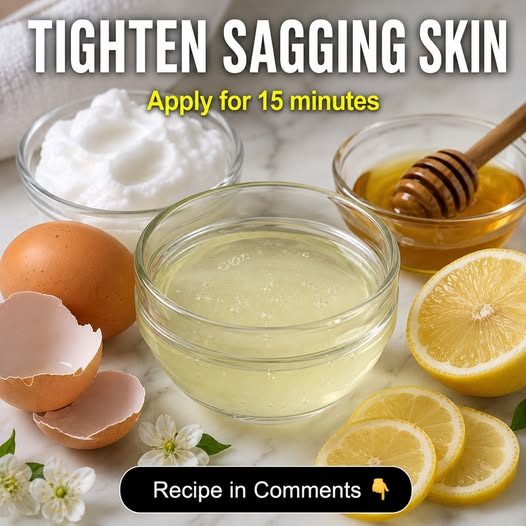
The photograph suggests an egg-white, yogurt, honey and lemon mask. Raw egg white dries into a tight film, but this sensation does not prove collagen production or permanent firming. Raw eggs can also contain Salmonella, which may contaminate the hands, face and nearby surfaces. Lemon has been excluded because citrus can irritate the skin and may cause a phototoxic reaction after sunlight exposure, sometimes followed by persistent pigmentation. (U.S. Food and Drug Administration)
The remedies below use safer ingredients selected for different skin types. Their ingredients have evidence for hydration, barrier support or protection from photoaging, but the exact homemade combinations have not undergone clinical trials. Always patch-test first.
Remedy 1: For Normal Skin
Yogurt, Honey and Green Tea Smoothing Mask
Ingredients and Scientific Benefits
- 1 teaspoon plain unsweetened yogurt: Naturally contains lactic acid, which can gently loosen dull surface cells.
- 1 teaspoon pure honey: Forms a moisture-retaining layer that helps reduce dryness.
- 1 teaspoon cooled green tea: Supplies antioxidant catechins that may help limit oxidative skin damage.
- 1 teaspoon clear aloe vera gel: Improves surface hydration through a humectant action.
- ½ teaspoon finely powdered colloidal oatmeal: Helps soothe irritation and strengthen the moisture barrier.
- ⅛ teaspoon vegetable glycerin: Attracts and retains water in the outer skin layer.
How the Ingredients Work Scientifically
Properly formulated lactic-acid products have improved signs of photoaged skin after approximately 12 weeks, but kitchen yogurt has an unpredictable lactic-acid concentration and should only be considered a mild conditioning ingredient. Green-tea research has shown microscopic improvement in elastic tissue, although obvious clinical tightening was not demonstrated during the study period. Aloe, oatmeal, honey and glycerin mainly increase hydration, which can make fine lines temporarily appear shallower. (PubMed)
Procedure
Mix all the ingredients in a clean bowl until smooth. Apply a thin, even layer over freshly cleansed skin, avoiding the eyelids and lips. Leave it on for eight minutes rather than waiting for it to dry completely. Rinse with lukewarm water and pat the face dry without rubbing.
How Often to Apply
Use once daily for three days. Continue for up to five days only when there is no stinging, rash or increased redness.
Initial Results
The skin may feel softer after the first application. Within two or three days, improved hydration may create a smoother, slightly plumper appearance. Structural sagging will not change in this short period.
Remedy 2: For Combination Skin
Soy Milk and Rice Balancing Firmness Mask
Ingredients and Scientific Benefits
- 1 tablespoon unsweetened soy milk: Contains proteins and naturally occurring soy isoflavones.
- 1 teaspoon fresh rice water: Provides lightweight starches that condition the skin surface.
- ½ teaspoon cosmetic-grade kaolin clay: Absorbs excess oil from the forehead, nose and chin.
- 1 teaspoon aloe vera gel: Hydrates without producing a heavy, greasy layer.
- ½ teaspoon colloidal oatmeal: Protects dry areas from becoming rough.
- 2 drops sunflower seed oil: Reduces moisture loss from the cheeks.
How the Ingredients Work Scientifically
Research on soy is strongest for standardized topical formulations and dietary supplementation rather than homemade soy-milk masks. A six-month randomized trial found that soy protein containing isoflavones improved hydration and some signs of facial photoaging in postmenopausal women. Kaolin temporarily reduces shine, while aloe, rice water, oatmeal and sunflower oil support a smoother barrier. These surface effects may make the face look more balanced, but they cannot tighten deeper tissues. (PubMed)
Procedure
Combine the soy milk, rice water and aloe gel. Mix in the oatmeal and kaolin until a soft paste forms. Add the sunflower oil. Apply a thin layer to the T-zone and an even lighter layer over the cheeks. Leave it on for five to seven minutes, rinsing before the clay becomes dry or cracked.
How Often to Apply
Use on alternate evenings for five days, providing two or three applications.
Initial Results
The T-zone may appear less oily after one use. By the third day, the cheeks may feel smoother and the entire face may look more refined because oiliness and dryness are better balanced.
Remedy 3: For Oily Skin
Green Tea and Bentonite Lightweight Mask
Ingredients and Scientific Benefits
- 1 teaspoon cosmetic-grade bentonite clay: Absorbs excess surface sebum.
- 1 tablespoon strongly brewed, cooled green tea: Provides antioxidant polyphenols.
- 1 teaspoon aloe vera gel: Supplies lightweight hydration.
- ½ teaspoon colloidal oatmeal: Helps prevent excessive dryness and irritation.
- ⅛ teaspoon vegetable glycerin: Maintains water in the outer skin layer.
- 1 teaspoon boiled and cooled water: Creates a spreadable consistency without fragrance.
How the Ingredients Work Scientifically
Oily skin can look loose or uneven when enlarged pores, excess shine and dehydration occur together. Bentonite absorbs surface oil but does not stimulate meaningful collagen production. Green-tea polyphenols may provide photoprotective and anti-inflammatory activity, while aloe, oatmeal and diluted glycerin help preserve hydration. Green tea supports protection from photoaging, but it does not replace sunscreen. (PubMed)
Procedure
Mix the clay and oatmeal first. Add the green tea, water, aloe and glycerin. Apply a very thin layer to oily areas, avoiding dry or irritated patches. Leave it on for five minutes and rinse while the mask is still slightly damp. Never allow it to become hard and cracked.
How Often to Apply
Apply every other evening for three to five days. Do not use it every night, as frequent clay application may damage the moisture barrier.
Initial Results
Surface shine may decrease after the first use. Within two or three applications, the skin may look smoother and less congested, creating a temporary firmer-looking finish.
Remedy 4: For Dry Skin
Honey, Oat and Dual-Oil Plumping Mask
Ingredients and Scientific Benefits
- 1 teaspoon pure honey: Holds moisture against the skin.
- 1 teaspoon aloe vera gel: Adds water-based hydration.
- 1 teaspoon colloidal oatmeal: Reduces roughness and supports barrier recovery.
- ¼ teaspoon vegetable glycerin: Functions as a strong humectant.
- 3 drops sunflower seed oil: Supplies barrier-supporting linoleic-acid-rich lipids.
- 2 drops jojoba oil: Softens dry skin and limits evaporation.
How the Ingredients Work Scientifically
Dryness makes creases and loose-looking texture more visible because the outer skin layer becomes less flexible. Glycerin attracts water, while honey, aloe and oatmeal improve surface moisture. Sunflower and jojoba oils form an emollient layer that slows water loss. Research indicates that sunflower oil preserves barrier integrity more effectively than olive oil, which is why olive oil has not been included. (PubMed)
Procedure
Combine the honey, aloe and glycerin. Mix in the oatmeal, then add both oils. Apply the mask to slightly damp skin without massaging aggressively. Leave it on for 10–12 minutes. Rinse gently and apply one additional drop of sunflower oil to extremely dry areas.
How Often to Apply
Use nightly for three to five days. People prone to clogged pores should apply the oils only to dry areas.
Initial Results
Tightness may improve after the first application. Fine dehydration lines may look softer within two or three days, giving the complexion a temporarily plumper appearance.
Remedy 5: For Sensitive Skin
Minimal Rice, Oat and Aloe Compress
Ingredients and Scientific Benefits
- 1 tablespoon boiled and cooled water: Creates a simple fragrance-free base.
- 1 teaspoon fresh rice water: Provides lightweight surface conditioning.
- 1 teaspoon colloidal oatmeal: Helps calm dryness, itching and barrier disturbance.
- 1 teaspoon aloe vera gel: Supports gentle hydration.
- ⅛ teaspoon vegetable glycerin: Retains water when used in a diluted mixture.
- 2 drops sunflower seed oil: Reduces moisture loss without essential oils or perfume.
How the Ingredients Work Scientifically
Sensitive skin may look rough or prematurely lined when its barrier is repeatedly irritated. Colloidal oatmeal has demonstrated anti-inflammatory effects and improvements in hydration, skin pH and barrier function. Aloe, glycerin and sunflower oil support moisture retention. These ingredients cannot lift sagging skin, but a calmer and better-hydrated surface generally looks smoother and more elastic. (PubMed)
Procedure
Mix all ingredients in a clean bowl. Soak a soft cotton cloth in the liquid and press it gently over the face for five minutes. Do not rub, pull or massage the skin. Rinse with cool-to-lukewarm water and pat dry.
How Often to Apply
Use once daily for three days. Continue for five days only when no burning, swelling, itching or rash occurs.
Initial Results
Mild dryness and tightness may improve within one to three days. Stop immediately if the skin becomes increasingly red, hot or uncomfortable.
Final Tips for Firmer-Looking Skin
Apply broad-spectrum, water-resistant SPF 30 or higher every morning. Ultraviolet exposure accelerates premature aging, including wrinkles and sagging, so sun protection is more important than any homemade mask. Seek shade, wear protective clothing and reapply sunscreen during prolonged outdoor exposure. (American Academy of Dermatology)
Cleanse gently, keep towels and applicators clean and avoid pulling the skin during facial massage. Do not apply lemon, raw eggs, baking soda, undiluted essential oils or rough sugar scrubs. Sleep adequately, avoid smoking and maintain a stable, healthy body weight.
Smoother hydration and glow may begin within two or three days. Fine dehydration lines can continue looking softer with regular moisturizing, but true wrinkle reduction and improvements in elasticity normally require weeks or months. Pronounced sagging may need dermatologist-supervised treatments because topical remedies cannot reach the deeper supporting tissues.
Diet Plan to Support Collagen and Healthy Skin
Follow this eating pattern for at least eight to twelve weeks rather than relying on a short detox.
For breakfast, have eggs, unsweetened yogurt, lentils or soy-based food with oats or whole-grain bread. Add a vitamin-C-rich fruit such as guava, kiwi, berries or orange. Vitamin C is required for normal collagen synthesis, but citrus should be eaten rather than applied directly to the face.
For lunch, choose fish, chicken, beans, chickpeas or lentils with leafy vegetables and brown rice or whole-grain bread. In the afternoon, eat a small handful of almonds, walnuts, pumpkin seeds or sunflower seeds. Dinner should include vegetables and a good protein source such as fish, tofu, chicken or beans.
Drink water regularly, limit smoking and reduce frequent sugary drinks and heavily refined foods. Soy foods may support skin health in some adults, but they must be consumed consistently for months rather than several days. People with soy allergies should avoid both topical and dietary soy.
Continue the appropriate home remedy for three to five days and maintain daily moisturization, sun protection and balanced nutrition for at least eight to twelve weeks. See a dermatologist if sagging appears suddenly, develops after major unexplained weight loss, is accompanied by a new skin growth or rash, or continues to cause concern. Medical procedures generally provide more meaningful tightening than homemade masks.
References for the above remedy
- American Academy of Dermatology Association. “Many Ways to Firm Sagging Skin.”
https://www.aad.org/public/cosmetic/younger-looking/firm-sagging-skin - American Academy of Dermatology Association. “11 Ways to Reduce Premature Skin Aging.”
https://www.aad.org/public/everyday-care/skin-care-secrets/anti-aging/reduce-premature-aging-skin - U.S. Food and Drug Administration. “What You Need to Know About Egg Safety.”
https://www.fda.gov/food/buy-store-serve-safe-food/what-you-need-know-about-egg-safety - DermNet. “Phytophotodermatitis.”
https://dermnetnz.org/topics/phytophotodermatitis - Beitner H. “Randomized, Placebo-Controlled, Double-Blind Study on the Clinical Efficacy of a Cream Containing 5% Lactic Acid.”
https://pubmed.ncbi.nlm.nih.gov/14616378/ - Chiu AE, et al. “Double-Blinded, Placebo-Controlled Trial of Green Tea Extracts in the Clinical and Histologic Appearance of Photoaging Skin.”
https://pubmed.ncbi.nlm.nih.gov/16029678/ - Dal’Belo SE, et al. “Moisturizing Effect of Cosmetic Formulations Containing Aloe Vera Extract.”
https://pubmed.ncbi.nlm.nih.gov/17026654/ - Capone K, et al. “Effects of Colloidal Oatmeal Topical Atopic Dermatitis Cream on Skin Microbiome and Skin Barrier Properties.”
https://pubmed.ncbi.nlm.nih.gov/32484623/ - Danby SG, et al. “Effect of Olive and Sunflower Seed Oil on the Adult Skin Barrier.”
https://pubmed.ncbi.nlm.nih.gov/22995032/ - Rizzo J, et al. “Soy Protein Containing Isoflavones Improves Facial Signs of Photoaging and Skin Hydration.”
https://pubmed.ncbi.nlm.nih.gov/37836398/