Visible facial pores commonly appear around the nose, cheeks, forehead and chin. They may become more noticeable when pores contain excess oil and dead skin, when acne repeatedly inflames the follicles, or when sun damage and ageing reduce the skin’s elasticity. Pores are normal openings of hair follicles and sebaceous glands, so they cannot be permanently closed. However, controlling surface oil, preventing congestion, improving hydration and protecting collagen can make them appear smaller and the complexion smoother. Research identifies excess sebum, reduced elasticity and increased follicle size as major factors behind enlarged facial pores. (PubMed)
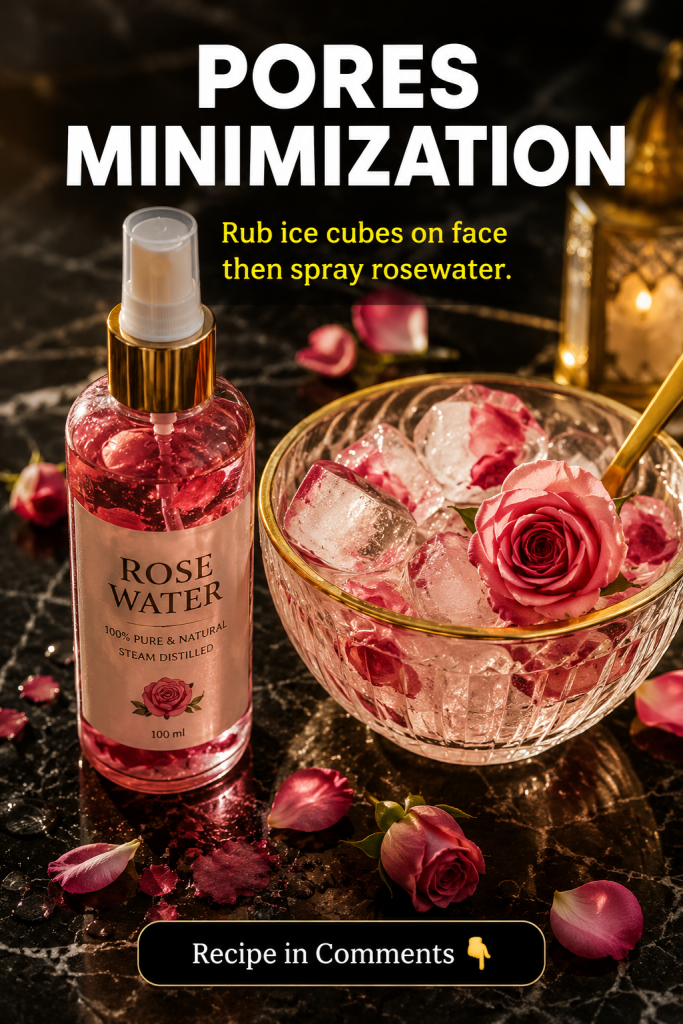
The ice-and-rosewater method shown in the image may create a brief tightening sensation because cold temporarily reduces skin temperature and blood flow. It does not change the anatomical size of a pore. Rubbing bare ice directly over the face may also cause redness, irritation, cold urticaria or cold-related skin injury, particularly when exposure is prolonged. Rosewater may feel refreshing, but there is no strong clinical evidence that it permanently shrinks pores. (PubMed)
The following natural remedies focus on making pores less visible by gently controlling oil, smoothing rough surface cells and supporting the skin barrier.

Remedy 1: Rosewater, Green Tea and Yogurt Mask for Normal Skin
Ingredients and Their Scientific Working
- Steam-distilled rosewater – 1 teaspoon: Rose hydrosol contains small amounts of aromatic plant compounds with laboratory-observed anti-inflammatory and antimicrobial activity. However, it should be regarded as a refreshing base rather than a clinically proven pore-shrinking treatment. (PubMed)
- Strong cooled green tea – 1 tablespoon: Green-tea catechins may help regulate surface oil and reduce oxidative stress. A controlled human study using formulated green-tea extract recorded reduced facial sebum after continued application. (PubMed)
- Plain unsweetened yogurt – 1 tablespoon: Yogurt provides hydration and naturally occurring lactic acid, which can gently loosen dull surface cells. A controlled facial-mask study reported improved moisture, brightness and elasticity with a formulated yogurt mask. (PubMed)
- Colloidal oatmeal – 1 teaspoon: Oat starches and beta-glucans retain water, while avenanthramides help calm irritation. Clinical trials have shown improved hydration and barrier function with colloidal-oat preparations. (PubMed)
- Pure aloe vera gel – 1 teaspoon: Aloe polysaccharides act as humectants. Human studies using standardized aloe extracts have shown short-term improvements in skin hydration. (PubMed)
Procedure
Combine all ingredients in a clean bowl. Apply a thin layer to washed, dry skin, concentrating on the nose and inner cheeks without scrubbing. Leave it on for eight to ten minutes. Rinse with lukewarm water, pat dry and apply a lightweight moisturizer.
How Often to Apply
Apply once daily for three days. Afterward, use it two or three times weekly if the skin remains comfortable.
Initial Results
Within one to three days, the face may feel softer and look smoother. Better hydration and removal of excess surface material may make pores temporarily less noticeable.
Remedy 2: Rice-Starch and Kaolin Two-Zone Mask for Combination Skin
Ingredients and Their Scientific Working
- Fresh rice-starch water – 1 tablespoon: Rice starch forms a light surface film and may support recovery of a weakened skin barrier. Human research found improved healing capacity in irritated skin exposed to rice-starch water. (PubMed)
- Kaolin clay – ½ teaspoon: Kaolin absorbs some surface oil, making it useful for the forehead, nose and chin. Its effect is temporary and mainly related to reducing shine.
- Colloidal oatmeal – 1 teaspoon: Oatmeal helps protect drier areas from the stripping effect of clay.
- Cooled green tea – 1 teaspoon: Green tea provides a lightweight antioxidant liquid and may help manage excess sebum with continued use.
- Vegetable glycerin – 1 drop: Glycerin attracts water into the outer skin layer. Randomized human testing has demonstrated increased skin moisture after using glycerin-based formulations. (PubMed)
Procedure
Mix the rice water, oatmeal and green tea. Add the kaolin and stir until smooth. Apply a thin layer over the oily T-zone. Add one drop of glycerin to the remaining mixture and apply it only over the drier cheeks. Rinse after seven to eight minutes before the clay becomes hard.
How Often to Apply
Use on alternate days for five days. Continue twice weekly afterward.
Initial Results
The T-zone may appear less shiny after the first application. Dry areas may feel more comfortable within two or three days, creating a more even-looking skin texture.
Remedy 3: Green Tea and Clay Pore-Care Pack for Oily Skin
Ingredients and Their Scientific Working
- Strong cooled green tea – 1 tablespoon: Controlled testing of topical green-tea formulations has shown gradual reductions in facial oil secretion, one of the major factors associated with visible pores. (PubMed)
- Kaolin clay – 1 teaspoon: Clay absorbs oil and temporarily reduces the reflective shine that can make pores look deeper.
- Plain yogurt – 2 teaspoons: Yogurt supplies moisture while its mild acidity helps lift loosely attached surface cells.
- Pure aloe vera gel – 1 teaspoon: Aloe prevents the clay from drying too firmly and supports short-term hydration.
- Finely ground colloidal oatmeal – ½ teaspoon: Oatmeal reduces friction and helps maintain the barrier while excess oil is being absorbed.
Procedure
Mix everything into a thin paste. Spread it lightly over the oily areas without massaging it into blackheads or pimples. Leave it on for five to seven minutes. Rinse before it cracks, then apply an oil-free, non-comedogenic moisturizer.
How Often to Apply
Use once daily for the first three days, followed by two applications weekly.
Initial Results
Surface oil may decrease from the first use. Pores may look cleaner and less prominent within one to three days, although clogged pores and blackheads require longer-term care.
Remedy 4: Rice, Oat and Honey Hydration Mask for Dry Skin
Ingredients and Their Scientific Working
- Fresh rice-starch water – 1 tablespoon: Rice starch supports surface softness and may assist barrier recovery.
- Colloidal oatmeal – 1 tablespoon: Oat compounds improve hydration and reduce rough, flaky texture that can exaggerate pores.
- Pasteurized honey – ½ teaspoon: Honey acts as a humectant and helps the mixture remain moist. Clinical testing of honey-containing creams has reported improvements in hydration and smoothness after continued use. (PubMed)
- Pure aloe vera gel – 1 tablespoon: Aloe adds lightweight water-binding polysaccharides.
- Cold-pressed sunflower seed oil – 1 drop: Sunflower oil is rich in linoleic acid. In an adult study, it preserved barrier integrity and improved hydration, whereas olive oil impaired the barrier. (PubMed)
Procedure
Combine the ingredients thoroughly. Apply a smooth layer without rubbing. Leave it on for ten minutes, rinse gently and immediately apply moisturizer while the skin is slightly damp.
How Often to Apply
Apply daily for three to five days. Continue two or three times weekly if it does not cause clogged pores.
Initial Results
Dryness and roughness may begin improving in one to three days. Hydrated skin reflects light more evenly, making pores and fine dehydration lines appear softer.
Remedy 5: Minimal Oat and Rice Compress for Sensitive Skin
Ingredients and Their Scientific Working
- Colloidal oatmeal – 1 tablespoon: Colloidal oatmeal has one of the stronger evidence bases among natural barrier-supporting ingredients and may reduce dryness and irritation. (PubMed)
- Fresh rice-starch water – 1 tablespoon: Rice starch provides a mild base without strong acids or abrasive particles.
- Cooled boiled water – 1 tablespoon: Dilution reduces the concentration of plant compounds touching reactive skin.
- Pure aloe vera gel – ½ teaspoon: Aloe may provide temporary hydration, but it should be omitted by anyone with a previous aloe reaction.
- Vegetable glycerin – 1 drop: A very small quantity supports moisture retention without making the mixture heavy.
Procedure
Mix the oatmeal with the two liquids, then add aloe and glycerin. Patch-test the mixture on the inner arm before facial use. Apply a thin layer for five minutes during the first treatment. Rinse gently with cool or lukewarm water.
How Often to Apply
Use every other day for three to five days. Continue twice weekly only if no irritation occurs.
Initial Results
Sensitive skin may feel calmer and less tight within two or three applications. Reduced redness and better hydration can make the skin surface appear more refined.
Final Tips for Making Pores Less Noticeable
Do not rub uncovered ice cubes over the face. For temporary cooling, wrap one ice cube in a clean, soft cloth and lightly press it against the skin for no more than 30 to 60 seconds at a time. Stop immediately if the skin becomes painful, numb, very pale or develops raised itchy patches.
Cleanse twice daily with lukewarm water and a gentle non-comedogenic cleanser. Hot water, squeezing, pore strips and rough scrubbing can irritate the follicle openings and make them appear more noticeable. Dermatologists also recommend non-comedogenic products, careful exfoliation, retinoids when appropriate and treatment of acne or sun damage. (American Academy of Dermatology)
Apply broad-spectrum SPF 30 or higher every morning. Ultraviolet exposure breaks down collagen and reduces support around follicle openings, contributing to increasingly visible pores over time.
Keep face cloths, makeup brushes, pillowcases and mask applicators clean. Prepare each food-based mask fresh and discard leftovers. Patch-test every new mixture.
A smoother, less oily appearance may begin within two to three days. Hydration may also temporarily soften fine dehydration lines and improve glow. Permanent pore closure and rapid removal of true wrinkles are not realistic outcomes. Clinically meaningful pore improvement generally requires several weeks and may involve retinoids, salicylic acid, niacinamide, chemical peels or professional procedures.
Diet Plan to Support Clear, Smooth-Looking Skin
Diet cannot directly close pores, but balanced nutrition can support normal barrier repair, collagen production and oil regulation.
Breakfast: Choose eggs, plain yogurt or unsweetened oats with guava, berries, kiwi or another vitamin-C-rich fruit.
Mid-morning: Eat a small portion of walnuts, almonds, pumpkin seeds or sunflower seeds and drink water according to thirst.
Lunch: Combine lentils, beans, fish or chicken with leafy vegetables, tomatoes and whole-grain rice or flatbread.
Evening snack: Choose whole fruit, roasted chickpeas or unsweetened yogurt instead of sugary drinks and refined snacks.
Dinner: Include vegetables, a protein source and a moderate portion of whole grains. Fish, walnuts and seeds provide healthy fats that support general skin function.
Continue the selected home remedy for four weeks while following consistent cleansing, moisturizing and sun protection. Consult a dermatologist if large pores remain accompanied by persistent blackheads, inflammatory acne, redness, scarring or rapidly worsening texture. Professional assessment is also advisable if the skin repeatedly burns, swells or develops a rash after home treatments.
References for the above remedy
- American Academy of Dermatology. What can treat large facial pores?
https://www.aad.org/public/everyday-care/skin-care-secrets/face/treat-large-pores - Lee SJ, et al. Facial Pores: Definition, Causes, and Treatment Options.
https://pubmed.ncbi.nlm.nih.gov/26918966/ - Ghassemi M, et al. The efficacy and adverse effects of treatment options for facial pores: A review article.
https://pubmed.ncbi.nlm.nih.gov/36440737/ - Mahmood T, et al. A comparison of the effects of topical green tea and lotus on facial sebum control in healthy humans.
https://pubmed.ncbi.nlm.nih.gov/23935347/ - Capone K, et al. Effects of colloidal oatmeal topical cream on skin-barrier properties.
https://pubmed.ncbi.nlm.nih.gov/32484623/ - Yeom G, et al. Clinical efficacy of facial masks containing yoghurt and natural ingredients.
https://pubmed.ncbi.nlm.nih.gov/22152494/ - De Paepe K, et al. Effect of rice starch on the barrier function of damaged skin.
https://pubmed.ncbi.nlm.nih.gov/12353708/ - Dal’Belo SE, et al. Moisturizing effect of cosmetic formulations containing Aloe vera extract.
https://pubmed.ncbi.nlm.nih.gov/17026654/ - Danby SG, et al. Effect of olive and sunflower seed oil on the adult skin barrier.
https://pubmed.ncbi.nlm.nih.gov/22995032/ - Chrit L, et al. Randomized study of human skin moisturization using a glycerol-based cream.
https://pubmed.ncbi.nlm.nih.gov/16679823/