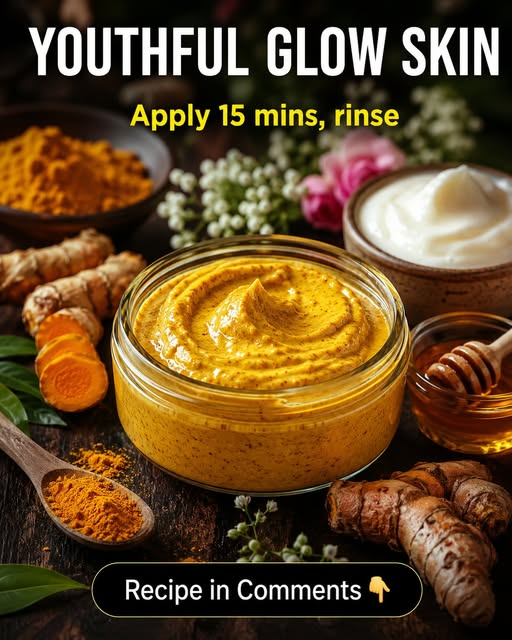
A youthful glow usually comes from a smooth, well-hydrated skin barrier rather than from a single 15-minute mask. Sun exposure, dryness, poor sleep, smoking, inflammation and gradual collagen loss can make the complexion look rough, tired or uneven. Natural remedies may temporarily improve softness, hydration and radiance, but they cannot erase deep wrinkles or reverse structural ageing within a few days. The turmeric, yogurt and honey mask shown in the image may offer mild antioxidant and moisturising effects, although turmeric can stain or irritate some skin types. Research supports selected turmeric, soy, oatmeal, green-tea and plant-oil preparations, but the complete homemade mixtures below have not been clinically tested as finished formulas. (PubMed)
Prepare each water-based remedy immediately before use, patch-test it for 24–48 hours and use only the recipe designed for your skin type.
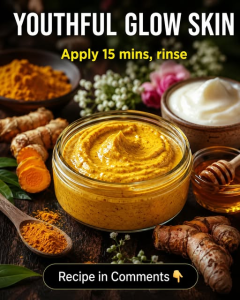
Remedy 1: For Normal Skin
Turmeric, Soy and Oat Radiance Mask
Ingredients
- 1 tablespoon plain unsweetened soy yogurt: soy compounds have clinical support for improving uneven pigmentation.
- A very small pinch of turmeric, approximately 1/16 teaspoon: supplies antioxidant and anti-inflammatory curcumin.
- 1 teaspoon cooled green tea: provides antioxidant catechins.
- ½ teaspoon colloidal oatmeal: supports barrier recovery and smooths roughness.
- ¼ teaspoon honey: provides a moisture-binding, softening base.
- 1 drop vegetable glycerin: attracts water into the skin’s outer layer.
Procedure
- Brew plain green tea and let it cool completely.
- Mix the soy yogurt, green tea and oatmeal.
- Add only a tiny pinch of turmeric to reduce staining and irritation.
- Stir in the honey and glycerin.
- Apply a thin layer to clean skin, avoiding the eyes and lips.
- Leave it on for eight to ten minutes.
- Rinse thoroughly with lukewarm water.
Scientific Working of the Ingredients
Controlled research supports topical soy preparations for improving blotchy pigmentation and skin tone. Turmeric and curcumin have shown potential benefits in studies of inflammation, photoageing and several skin conditions, but evidence remains preliminary and standardized creams are not equivalent to kitchen turmeric. Oatmeal and glycerin increase hydration, helping fine dehydration lines look temporarily softer. (PubMed)
How Often to Apply
Apply once daily for the first three days. Continue three evenings weekly for four to six weeks if the skin remains comfortable.
Initial Results
Skin may feel smoother and look fresher within one to three days. Uneven pigmentation and visible ageing require several weeks or months of consistent care.
Remedy 2: For Combination Skin
Rose, Green Tea and Jojoba Two-Zone Mask
Ingredients
- 1 teaspoon cosmetic-grade kaolin clay: absorbs excess surface oil from the T-zone.
- 1 tablespoon cooled rose-petal infusion: provides a refreshing antioxidant base.
- 1 teaspoon pure aloe vera gel: hydrates without a heavy finish.
- ½ teaspoon colloidal oatmeal: protects dry areas from over-stripping.
- 1 teaspoon strained cucumber water: adds lightweight hydration.
- 2 drops jojoba oil: conditions dry cheeks and mouth areas.
Procedure
- Make a weak infusion using clean, food-grade dried rose petals and allow it to cool.
- Combine the kaolin, oatmeal, rose infusion, cucumber water and aloe.
- Apply the plain mixture to the forehead, nose and chin.
- Add the jojoba oil to the portion remaining in the bowl.
- Apply the oil-enriched portion to dry cheek areas.
- Leave it on for five to seven minutes.
- Rinse before the clay becomes completely dry or cracked.
Scientific Working of the Ingredients
Kaolin temporarily removes surface oil, while aloe and oatmeal help maintain hydration. A recent controlled trial found improvements in photoageing with a standardized anthocyanin-rich rose-petal extract over 12 weeks. A homemade rose infusion is much weaker and should be viewed as a soothing base rather than a clinically equivalent anti-ageing treatment. (PubMed)
How Often to Apply
Use twice during the first five days, followed by once or twice weekly for six weeks.
Initial Results
The T-zone may appear less shiny after one use. Dry areas may feel smoother within two or three applications.
Remedy 3: For Oily Skin
Rice Starch and Green Tea Glow Mask
Ingredients
- 1 teaspoon pure rice starch: creates a soft, oil-absorbing base.
- ½ teaspoon cosmetic-grade kaolin clay: reduces excess surface shine.
- 1 tablespoon cooled green tea: supplies antioxidant polyphenols.
- 1 teaspoon pure aloe vera gel: hydrates without a rich oil.
- 1 teaspoon cucumber water: adds cooling moisture.
- 1 drop vegetable glycerin: helps prevent excessive tightness.
Procedure
- Mix the rice starch and kaolin in a clean bowl.
- Add the green tea and cucumber water gradually.
- Stir in the aloe gel and one drop of glycerin.
- Apply a thin layer to oily areas.
- Leave it on for only three to five minutes.
- Rinse while the mask is still slightly damp.
- Follow with a lightweight, non-comedogenic moisturiser.
Scientific Working of the Ingredients
Rice-starch exposure improved the recovery of experimentally damaged skin in a clinical study, although the research used rice-starch bath water rather than a facial mask. Green-tea extracts have antioxidant, anti-inflammatory and oil-related benefits, while kaolin removes existing surface oil. Aloe and glycerin prevent the skin from feeling stripped. (PubMed)
How Often to Apply
Apply once during the first three days. Continue once or twice weekly for four weeks.
Initial Results
Oiliness may look reduced immediately after rinsing. Smoother-looking texture may become noticeable within two to three days, but the mask will not permanently change pore size or oil production.
Remedy 4: For Dry Skin
Chia, Sunflower and Oat Moisture Mask
Ingredients
- 1 tablespoon plain unsweetened soy yogurt: provides a creamy, moisturising base.
- 1 teaspoon colloidal oatmeal: reduces roughness and scaling.
- ½ teaspoon cosmetic-grade chia-seed oil: supplies linoleic and alpha-linolenic fatty acids.
- ½ teaspoon high-linoleic sunflower-seed oil: supports the lipid barrier.
- 1 teaspoon aloe vera gel: provides water-based hydration.
- 2 drops vegetable glycerin: increases moisture retention.
Procedure
- Combine the soy yogurt, aloe and glycerin.
- Add the colloidal oatmeal and let it soften for two minutes.
- Mix the chia and sunflower oils separately.
- Stir the oil blend into the creamy base.
- Apply a thin layer to slightly damp skin.
- Leave it on for ten minutes.
- Rinse lightly without scrubbing.
Scientific Working of the Ingredients
A clinical evaluation of formulated chia-seed extract reported improved hydration and barrier function. Plain chia oil is not identical to the tested extract but provides related fatty acids. Sunflower oil preserved barrier integrity and improved hydration in an adult skin study, while colloidal oatmeal improves dryness, roughness and barrier defects. (PubMed)
How Often to Apply
Apply nightly for three to five days, followed by three applications weekly for six weeks.
Initial Results
Dryness and tightness may improve after the first application. The complexion can appear plumper and more luminous within two to three days as hydration increases.
Remedy 5: For Sensitive Skin
Minimal Rice and Oat Barrier Compress
Ingredients
- 1 tablespoon cooled boiled water: creates a simple fragrance-free base.
- 1 teaspoon pure rice starch: forms a gentle, softening suspension.
- 1 teaspoon colloidal oatmeal: supports irritated or weakened skin.
- 1 teaspoon strained cucumber water: provides mild cooling.
- 1 drop vegetable glycerin: helps retain moisture.
- 2 drops sunflower-seed oil: adds a light protective lipid layer.
Procedure
- Mix the rice starch and oatmeal with cooled boiled water.
- Let the mixture stand for five minutes.
- Add the cucumber water and glycerin.
- Patch-test it beside the jaw for 24–48 hours.
- Apply a thin layer for three minutes only.
- Rinse gently and press the sunflower oil over damp skin.
- Stop immediately if burning, itching or swelling develops.
Scientific Working of the Ingredients
Colloidal oatmeal has demonstrated anti-inflammatory and barrier-repair benefits in clinical research. Rice starch may support recovery of damaged skin, while sunflower oil supplies linoleic-acid-rich barrier lipids. Turmeric, honey, fragrance, rosewater and essential oils are intentionally excluded because sensitive skin may react to otherwise natural ingredients. (PubMed)
How Often to Apply
Use every other evening for the first five days. Continue twice weekly only when the skin remains calm.
Initial Results
Mild tightness and roughness may improve within one to three applications. This remedy will not treat rosacea, eczema or an allergic rash.
Final Tips for a Lasting Youthful Glow
Apply broad-spectrum SPF 30 or higher every morning. A randomized trial found substantially less visible skin ageing among people assigned to daily sunscreen use, making sun protection more dependable than any homemade anti-ageing mask. (PubMed)
Use lukewarm water, moisturise while the skin is slightly damp and avoid lemon juice, baking soda, toothpaste, harsh scrubs and undiluted essential oils. Keep makeup brushes, facial cloths and applicators clean. Never store homemade water-based masks because they do not contain preservatives.
Aim for seven to nine hours of sleep. Poor sleepers have shown slower barrier recovery and more visible ageing-related changes, while even brief sleep deprivation can worsen hydration, texture and skin gloss. (PubMed)
Improved softness and glow may begin within two to three days. Fine dehydration lines may look temporarily reduced, but collagen, firmness and pigmentation require consistent care for at least eight to twelve weeks.
Diet Plan for Youthful Glowing Skin
Breakfast: Eat eggs, plain yogurt, lentils or tofu with guava, kiwi, berries or citrus fruit. Vitamin C is necessary for normal collagen formation. (Office of Dietary Supplements)
Lunch: Choose fish, chicken, beans or chickpeas with colourful vegetables and whole grains.
Snack: Select whole fruit, walnuts, pumpkin seeds or plain yogurt instead of sweetened drinks and pastries.
Dinner: Include vegetables, protein and unsaturated fats from avocado, fish, nuts or seeds. A small controlled study associated regular avocado consumption with improved facial firmness and elasticity, although it was not a cure for ageing. (PubMed)
Continue the selected remedy for six to eight weeks and maintain the diet and sunscreen routine for at least twelve weeks. Consult a dermatologist when dryness, pigmentation, itching, acne or redness continues despite gentle care. Seek medical advice sooner for a rapidly changing mark, bleeding lesion, painful rash, facial swelling or a wound that does not heal.
References for the above remedy
- Vaughn AR, et al. Effects of Turmeric on Skin Health: A Systematic Review.
https://pubmed.ncbi.nlm.nih.gov/27213821/ - Leyden J, et al. The Mechanism of Action and Clinical Benefits of Soy for the Treatment of Hyperpigmentation.
https://pubmed.ncbi.nlm.nih.gov/21332714/ - Dhaliwal S, et al. Bakuchiol and Retinol for Facial Photoageing: A Randomized Double-Blind Study.
https://pubmed.ncbi.nlm.nih.gov/29947134/ - Capone K, et al. Effects of Colloidal Oatmeal on Skin Barrier Function.
https://pubmed.ncbi.nlm.nih.gov/32484623/ - Danby SG, et al. Effect of Olive and Sunflower Seed Oil on the Adult Skin Barrier.
https://pubmed.ncbi.nlm.nih.gov/22995032/ - Decker A, et al. Topical Chia Seed Extract Improves Skin Hydration.
https://pubmed.ncbi.nlm.nih.gov/32378329/ - De Paepe K, et al. Effect of Rice Starch on Damaged Skin-Barrier Recovery.
https://pubmed.ncbi.nlm.nih.gov/12353708/ - Hughes MCB, et al. Sunscreen and Prevention of Skin Aging: A Randomized Trial.
https://pubmed.ncbi.nlm.nih.gov/23732711/ - Oyetakin-White P, et al. Does Poor Sleep Quality Affect Skin Ageing?
https://pubmed.ncbi.nlm.nih.gov/25266053/ - National Institutes of Health, Office of Dietary Supplements. Vitamin C: Health Professional Fact Sheet.
https://ods.od.nih.gov/factsheets/VitaminC-HealthProfessional/