A sun tan develops when ultraviolet radiation stimulates the skin to produce additional melanin. Although tanning is often treated as a cosmetic concern, it is actually a sign that ultraviolet exposure has injured the skin. A homemade mask cannot erase a tan in ten minutes or reverse ultraviolet-related DNA damage. However, gentle barrier-supporting ingredients may reduce dryness, dullness and uneven surface texture while the excess pigment gradually fades. Consistent sun protection is the most important step because repeated exposure continually stimulates new pigmentation. (American Academy of Dermatology)
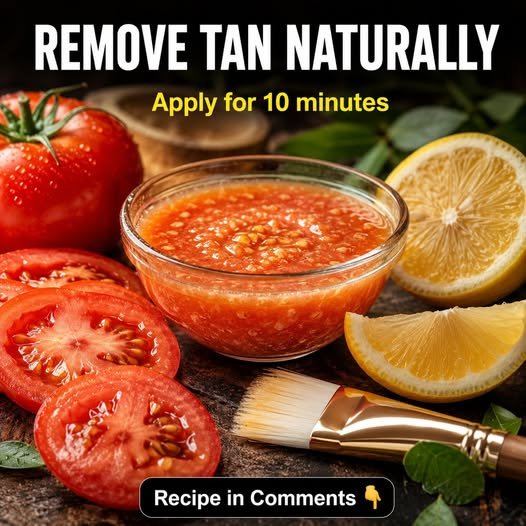
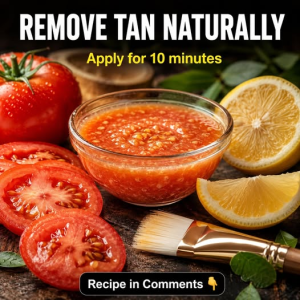
The tomato-and-lemon remedy shown in the image should be approached cautiously. Eating tomatoes provides lycopene that has been studied for protection against ultraviolet-related damage, but there is no strong clinical evidence that raw tomato pulp rapidly removes an existing tan when applied to the face. Lemon juice is more concerning because citrus compounds can react with sunlight and cause phytophotodermatitis, sometimes leaving burns and darker pigmentation. Therefore, the following remedies exclude lemon juice and other harsh bleaching ingredients. (PubMed)
The exact homemade mixtures below have not been tested as complete clinical formulations. Their benefits are based on studies of individual ingredients such as soy, green tea, colloidal oatmeal, rice starch and lactic acid. Complete a 24-hour patch test before applying any remedy to the face.
Remedy 1: Soy, Green Tea and Oat Mask for Normal Skin
Ingredients
- Unsweetened soy milk: 1 tablespoon
- Cooled green tea: 1 tablespoon
- Colloidal oatmeal: 1 teaspoon
- Pure aloe vera gel: 1 teaspoon
- Rice starch: ½ teaspoon
- Honey: ½ teaspoon
Scientific Working of Each Ingredient
Soy milk: Soy contains proteins and serine-protease inhibitors that have been investigated for reducing mottled pigmentation and uneven tone. A double-blind clinical study found that a formulated soy moisturiser improved pigmentation, blotchiness and dullness more effectively than its inactive base. Homemade soy milk is less concentrated and should be considered supportive rather than equivalent to the tested formulation. (PubMed)
Green tea: Green-tea polyphenols provide antioxidant and anti-inflammatory activity. Human studies have found that topical green-tea extracts can reduce several ultraviolet-related changes, although green tea has almost no sunscreen value by itself. (PubMed)
Colloidal oatmeal: Oat beta-glucans and avenanthramides help improve hydration, scaling, roughness and barrier comfort.
Aloe vera: Aloe-based formulations can increase surface hydration, but aloe has not been shown to bleach a suntan.
Rice starch: Rice starch has demonstrated barrier-supporting effects in damaged skin.
Honey: Honey works mainly as a humectant, helping the mask remain moist and reducing a tight after-feel. (PubMed)
Procedure
Mix the oatmeal and rice starch first. Add the soy milk and green tea gradually, followed by aloe and honey. Stir until the mixture forms a smooth, thin paste.
Apply it to cleansed skin without rubbing. Leave it on for eight to ten minutes and rinse with lukewarm water. Pat the face dry and apply moisturiser.
How Often to Apply
Use once daily for three days. Afterward, apply two or three times weekly for up to four weeks.
Initial Results
Within one to three days, the skin may feel softer, less dry and more luminous. A visible tan is unlikely to disappear in this period.
Remedy 2: Gentle Yogurt and Rice Mask for Combination Skin
Ingredients
- Plain unsweetened yogurt: 1 tablespoon
- Rice starch: 1 teaspoon
- Cooled green tea: 1 teaspoon
- Colloidal oatmeal: ½ teaspoon
- Pure aloe vera gel: 1 teaspoon
- Sunflower seed oil: 1 drop
Scientific Working of Each Ingredient
Plain yogurt: Yogurt contains naturally occurring lactic acid. Clinical studies of properly formulated topical lactic acid found improvements in skin smoothness and epidermal renewal. However, yogurt contains a lower and unpredictable concentration, so it should not be expected to work like a professional chemical exfoliant. (PubMed)
Rice starch and oatmeal: These ingredients support barrier recovery and soften rough surface cells without physical scrubbing.
Green tea: Antioxidant polyphenols help calm the appearance of environmental stress.
Aloe vera: Provides lightweight hydration to both oily and dry facial areas.
Sunflower seed oil: A single drop can soften dry cheeks. Research found that sunflower oil preserved barrier integrity and improved hydration, unlike olive oil, which impaired the barrier in the same study. (PubMed)
Procedure
Combine the yogurt, rice starch and oatmeal. Add green tea and aloe, then mix in one drop of sunflower oil.
Apply a thin layer over the face, using slightly less on the oily forehead and nose. Leave it on for five to seven minutes, then rinse gently.
How Often to Apply
Use on alternate days for five days. Continue no more than twice weekly if the skin remains comfortable.
Initial Results
Roughness and dullness may begin improving within two or three applications. Stop using the mask if it causes burning, prolonged redness or peeling.
Remedy 3: Green Tea, Soy and Kaolin Mask for Oily Skin
Ingredients
- Kaolin clay: 1 teaspoon
- Unsweetened soy milk: 1 tablespoon
- Cooled green tea: 1 tablespoon
- Pure aloe vera gel: 1 teaspoon
- Colloidal oatmeal: ½ teaspoon
- Rice starch: ½ teaspoon
Scientific Working of Each Ingredient
Kaolin clay: Kaolin absorbs surface oil and can temporarily reduce excessive shine. This may make the complexion appear clearer, but it does not extract melanin or permanently remove a tan.
Soy milk: Soy-derived compounds have stronger clinical support for uneven pigmentation than most traditional kitchen ingredients, although a homemade mask is less reliable than a standardised formulation.
Green tea: Helps reduce oxidative stress and inflammatory redness after environmental exposure.
Aloe, oatmeal and rice starch: These ingredients prevent the clay mixture from becoming excessively drying and support the outer skin barrier. (PubMed)
Procedure
Mix the kaolin, oatmeal and rice starch. Add soy milk, green tea and aloe until a thin paste forms.
Apply mainly to oily or visibly dull areas. Do not allow the mask to become completely hard or cracked. Rinse after five to six minutes while it is still slightly damp.
How Often to Apply
Apply on day one and day four of the first five-day routine. Continue once weekly if necessary.
Initial Results
Surface oil may decrease after the first application. The face may look fresher within one to three days, but this is due to oil control and hydration rather than rapid melanin removal.
Remedy 4: Honey, Oat and Sunflower Mask for Dry Skin
Ingredients
- Colloidal oatmeal: 1 tablespoon
- Pure honey: 1 teaspoon
- Aloe vera gel: 1 tablespoon
- Plant-derived glycerin: 2 drops
- Sunflower seed oil: 3 drops
- Mashed ripe avocado: 1 teaspoon
Scientific Working of Each Ingredient
Oatmeal: Helps reduce dryness, roughness and irritation while supporting barrier function.
Honey and glycerin: These humectants attract water toward the outer skin layer, creating a temporary plumping effect.
Sunflower seed oil: Supplies linoleic acid and helps slow moisture loss.
Aloe vera: Adds water-based hydration but should not be described as a tan-removing ingredient. A controlled trial found that aloe cream did not prevent or bleach suntan.
Avocado: Its fatty components improve softness, although evidence for directly treating pigmentation is lacking. (PubMed)
Procedure
Mash the avocado until completely smooth. Add oatmeal, aloe, honey, glycerin and sunflower oil. Apply the mixture to clean, slightly damp skin.
Leave it on for ten minutes, rinse gently and immediately apply a fragrance-free moisturiser.
How Often to Apply
Use once daily for three days, then twice weekly for another three weeks.
Initial Results
Dryness and flaking may improve within one or two applications. Well-hydrated skin reflects light more evenly, which may make the tan appear less dull.
Remedy 5: Minimal Rice and Oat Compress for Sensitive Skin
Ingredients
- Colloidal oatmeal: 1 tablespoon
- Rice starch: 1 teaspoon
- Boiled and cooled water: 2 tablespoons
- Plant-derived glycerin: 1 drop
- Sunflower seed oil: 1 drop
Scientific Working of Each Ingredient
Sensitive skin can develop additional pigmentation after irritation, so this remedy avoids acids, citrus, fragrance, essential oils and abrasive particles. Colloidal oatmeal has documented anti-inflammatory and barrier-supportive effects, while rice starch has been shown to improve the recovery of damaged skin. Glycerin and one drop of sunflower oil reduce dryness without creating a complicated mixture. (PubMed)
Procedure
Mix the oatmeal and rice starch. Add the cooled water slowly until a thin paste forms. Stir in the glycerin and sunflower oil.
Apply a small amount to one facial area first. If it feels comfortable, spread a thin layer over the remaining tanned areas. Leave it on for three to five minutes and rinse.
How Often to Apply
Use once on the first day. If no reaction develops, repeat on day three and day five.
Initial Results
The skin may feel calmer and less rough within one to three days. This remedy supports healing but does not bleach the skin.
Why Tomato and Lemon Should Not Be Applied Together
Tomatoes are nutritious and their lycopene content may provide some protection when eaten consistently, but rubbing tomato pulp over the face has not been clinically proven to remove an established tan. Lemon juice is acidic and contains photosensitising compounds. Sun exposure after citrus contact can cause inflammation, blisters and prolonged hyperpigmentation—the opposite of the intended result. (PubMed)
Also avoid baking soda, undiluted vinegar, toothpaste, bleach, coarse sugar, salt scrubs and aggressive rubbing. Irritation can damage the barrier and lead to longer-lasting discolouration, especially in medium and deeper skin tones.
Final Tips for Faster and Safer Tan Fading
Apply a broad-spectrum, water-resistant sunscreen with SPF 30 or higher every morning. Use enough to cover the face, ears and neck, and reapply every two hours outdoors or immediately after swimming and sweating. A tinted sunscreen containing iron oxide provides additional protection from visible light, which can contribute to pigmentation. (American Academy of Dermatology)
Seek shade, wear a wide-brimmed hat and cover exposed arms and legs. Do not scrub peeling or sunburned skin. Keep facial brushes, towels and mixing utensils clean, and discard water-containing homemade mixtures after one application.
A smoother glow may become noticeable within two or three days. Genuine tan fading usually takes several weeks and depends heavily on avoiding repeated ultraviolet exposure. Improvement in dryness and fine surface lines may continue with regular moisturising and sun protection, but home remedies cannot reverse deep wrinkles or significant photodamage.
Diet Plan to Support Sun-Damaged Skin
Follow this diet plan for at least eight to twelve weeks alongside daily sun protection.
Breakfast: Eat eggs, plain yogurt or unsweetened soy food with oatmeal or whole-grain bread. Add guava, oranges, berries or kiwi for vitamin C.
Lunch: Include lentils, beans, chicken or fish with leafy vegetables, tomatoes and a whole-grain carbohydrate.
Snack: Choose fresh fruit with a small serving of walnuts, almonds, pumpkin seeds or sunflower seeds.
Dinner: Eat fish, tofu, eggs, beans or lean meat with cooked vegetables. Protein supplies amino acids required for normal skin repair.
Tomato intake: Cooked tomato paste eaten with a small amount of dietary fat provides absorbable lycopene. In a randomised controlled study, daily tomato paste containing lycopene for 12 weeks reduced several measurements of ultraviolet-related skin damage. This provides internal support but does not replace sunscreen. (PubMed)
Fluids: Drink water according to thirst, activity and climate. Hydration supports normal skin function but will not directly bleach pigmentation.
Continue the selected home remedy for three to four weeks if it causes no irritation. Consult a dermatologist if the discolouration remains unchanged after six to eight weeks, becomes patchy, rapidly darkens or appears with itching, scaling, pain or changing moles. Seek medical help promptly for severe sunburn with widespread blistering, fever, dizziness, vomiting or dehydration.
References for the above remedy
- American Academy of Dermatology Association. How to Apply Sunscreen.
https://www.aad.org/public/everyday-care/sun-protection/shade-clothing-sunscreen/how-to-apply-sunscreen - American Academy of Dermatology Association. Practice Safe Sun.
https://www.aad.org/public/everyday-care/sun-protection/shade-clothing-sunscreen/practice-safe-sun - Wallo W, et al. Efficacy of a Soy Moisturizer in Photoaging: A Double-Blind, Vehicle-Controlled Study.
https://pubmed.ncbi.nlm.nih.gov/17941363/ - Hermanns JF, et al. Assessment of Topical Hypopigmenting Agents on Solar Lentigines.
https://pubmed.ncbi.nlm.nih.gov/12077522/ - Elmets CA, et al. Cutaneous Photoprotection from Ultraviolet Injury by Green Tea Polyphenols.
https://pubmed.ncbi.nlm.nih.gov/11209110/ - Capone K, et al. Effects of Colloidal Oatmeal on Skin Barrier Properties and Hydration.
https://pubmed.ncbi.nlm.nih.gov/32484623/ - De Paepe K, et al. Effect of Rice Starch on Skin Barrier Function.
https://pubmed.ncbi.nlm.nih.gov/12353708/ - Smith WP. Epidermal and Dermal Effects of Topical Lactic Acid.
https://pubmed.ncbi.nlm.nih.gov/8784274/ - Danby SG, et al. Effect of Olive and Sunflower Seed Oil on the Adult Skin Barrier.
https://pubmed.ncbi.nlm.nih.gov/22995032/ - Rizwan M, et al. Tomato Paste Rich in Lycopene Protects Against Cutaneous Photodamage in Humans.
https://pubmed.ncbi.nlm.nih.gov/20854436/