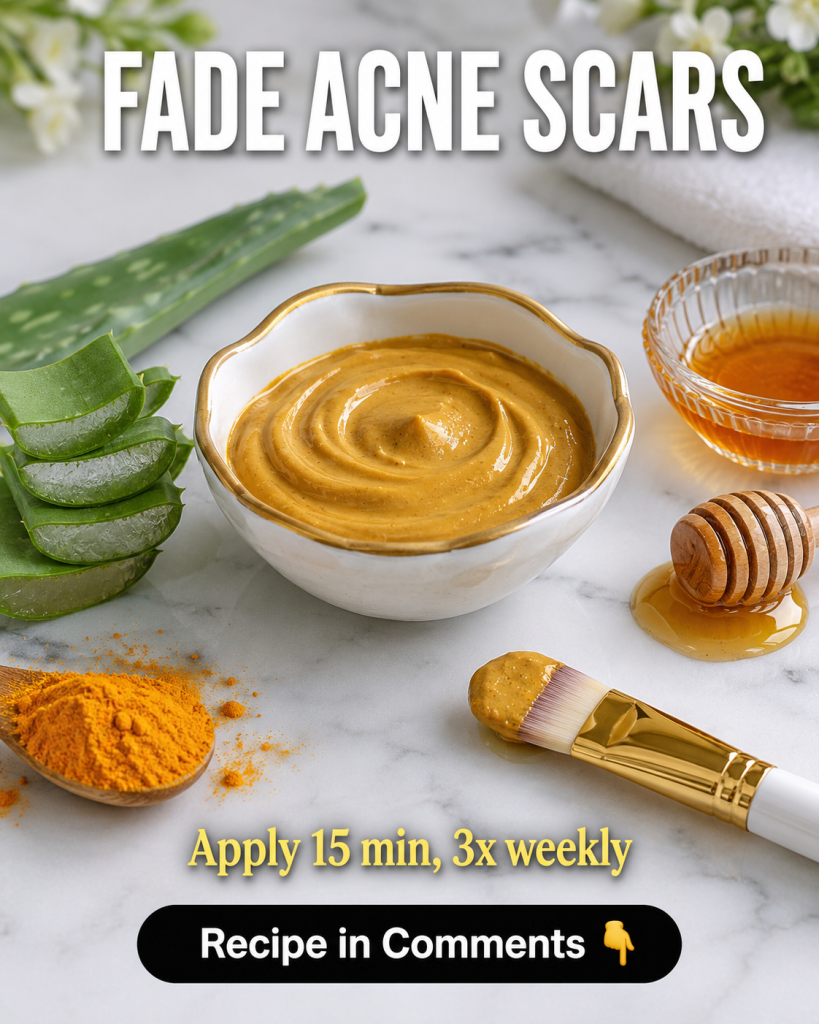
Acne can affect confidence long after an active breakout has healed. The flat red, brown, or grey marks left behind are often called acne scars, but many are actually post-inflammatory hyperpigmentation, or PIH. These marks can gradually fade as the skin renews itself. True acne scars, including deep pits, rolling depressions, raised scars, and keloids, involve structural changes in the skin and usually require professional treatment. Home remedies cannot rebuild deep scar tissue, but carefully selected natural ingredients may calm inflammation, support the skin barrier, prevent new breakouts, and gradually improve the appearance of uneven pigmentation. (American Academy of Dermatology)
The following remedies are designed mainly for flat, discoloured post-acne marks. The scientific evidence generally relates to the individual ingredients or standardized topical preparations rather than these exact homemade mixtures. Therefore, realistic improvement requires consistency, sun protection, gentle skincare, and patience.
Remedy 1: Antioxidant Oat and Turmeric Mask for Normal Skin
Ingredients and Their Scientific Benefits
Use one tablespoon of finely ground colloidal oatmeal to reduce dryness and support the protective skin barrier; two teaspoons of freshly brewed and cooled green tea for antioxidant and anti-inflammatory polyphenols; one teaspoon of pure inner-leaf aloe vera gel for soothing hydration; half a teaspoon of honey to retain moisture; one teaspoon of unsweetened soy milk to provide gentle plant proteins; and a very small pinch of turmeric for curcumin-derived antioxidant support.
Scientific Working of the Ingredients
Colloidal oatmeal contains compounds called avenanthramides that possess anti-inflammatory and antioxidant properties. Clinical research has found that oatmeal preparations can improve hydration, skin pH, roughness, and barrier function. Green-tea polyphenols, especially EGCG, may reduce skin inflammation and help control active acne, which is important because preventing new breakouts also prevents new marks. Aloe gel provides a cooling, water-rich base, while turmeric may help reduce inflammatory activity. Soy-derived ingredients have also been investigated for their ability to improve uneven pigmentation. (PubMed)
Procedure
Mix the oatmeal and cooled green tea until a smooth paste forms. Stir in the aloe, honey and soy milk. Add only a tiny pinch of turmeric to prevent excessive staining. Apply a thin layer to clean skin, avoiding the eyes, nostrils and broken pimples. Leave it on for 10 minutes, soften it with water and rinse without scrubbing.
How Often to Apply
Apply three times during the first five days, with at least one rest day between applications. Continue twice weekly for eight weeks when the skin remains comfortable.
Initial Results
Within one to three days, the face may feel softer, calmer and better hydrated. Dark marks will not disappear in three days; early fading usually requires several weeks.
Remedy 2: Two-Zone Licorice and Aloe Treatment for Combination Skin
Ingredients and Their Scientific Benefits
Combine one tablespoon of colloidal oatmeal for barrier support, two teaspoons of cooled green tea for the oily T-zone, one teaspoon of aloe gel for lightweight hydration, one-eighth teaspoon of finely sifted licorice-root powder for pigmentation support, half a teaspoon of honey for moisture retention and one teaspoon of unsweetened soy milk for a smoother texture.
Scientific Working of the Ingredients
Licorice contains compounds such as glabridin that can interfere with tyrosinase, an enzyme involved in melanin production. However, clinical evidence is stronger for standardized licorice extracts than for homemade root powder, so results from this remedy may be mild and variable. Green tea suits oilier areas because topical green-tea preparations have shown benefits for acne. Oatmeal, aloe and honey help keep the drier areas from feeling tight. (PubMed)
Procedure
Mix all ingredients into a creamy paste. Apply a thin layer over the forehead, nose and chin. Add a little more aloe to the remaining mixture and use it on the cheeks. Leave both areas covered for 8–10 minutes. Rinse gently with lukewarm water.
How Often to Apply
Use on alternate evenings for five days. After that, apply twice weekly for six to eight weeks.
Initial Results
The T-zone may look less greasy while the cheeks feel more comfortable within one to three days. A visible change in brown marks should be judged after at least six weeks.
Remedy 3: Green-Tea Scar-Support Gel for Oily and Acne-Prone Skin
Ingredients and Their Scientific Benefits
Prepare three teaspoons of strongly brewed cooled green tea, one tablespoon of pure aloe gel, one teaspoon of colloidal oatmeal, half a teaspoon of honey, one-eighth teaspoon of licorice-root powder and a tiny pinch of turmeric.
Scientific Working of the Ingredients
This preparation focuses on controlling the inflammation that can cause fresh pigmentation. Topical green-tea extract has performed favourably in clinical studies of mild-to-moderate acne, although homemade tea is less concentrated than researched extracts. Aloe provides hydration without a heavy oily base. Oatmeal reduces the risk of over-drying, while licorice and turmeric supply plant compounds associated with pigmentation control and anti-inflammatory activity. (PubMed)
Procedure
Whisk the aloe and green tea together. Add the oatmeal, honey, licorice and turmeric. Spread a very thin layer over areas containing healed marks. Do not apply it over bleeding, picked or infected pimples. Leave for 7–8 minutes and rinse.
Prepare a fresh portion each time rather than storing the mixture, because homemade water-based preparations have no preservative.
How Often to Apply
Apply three times over five days. If no burning, rash or increased acne occurs, continue two or three times weekly for eight weeks.
Initial Results
Temporary redness and surface oiliness may look reduced within one to three days. Established pigmentation requires considerably longer.
Remedy 4: Sunflower, Honey and Oat Emulsion for Dry Skin
Ingredients and Their Scientific Benefits
Use one tablespoon of colloidal oatmeal, two teaspoons of cooled green tea, one teaspoon of aloe gel, one teaspoon of unsweetened soy milk, half a teaspoon of honey and three drops of pure sunflower-seed oil.
Scientific Working of the Ingredients
Dry, damaged skin can become irritated easily, and repeated irritation may make post-acne discoloration appear more noticeable. Sunflower-seed oil is rich in linoleic acid and has been shown to preserve skin-barrier integrity and improve hydration. Oatmeal provides additional barrier support, while honey and aloe help retain water. Soy and green tea contribute antioxidant compounds without using a harsh physical scrub. (PubMed)
Procedure
Combine the oatmeal, green tea, aloe, soy milk and honey. Add three drops of sunflower oil and mix until emulsified. Press the mixture gently over dry areas rather than rubbing it into the skin. Leave for 10–12 minutes and rinse with comfortably warm water.
How Often to Apply
Apply on days one, three and five. Continue twice weekly for eight to twelve weeks if the skin remains clear and comfortable.
Initial Results
Dryness and tightness may improve after the first few applications. The skin may look smoother within three days because it is better hydrated, but this should not be mistaken for permanent scar removal.
Remedy 5: Minimal Oat Compress for Sensitive Skin
Ingredients and Their Scientific Benefits
Combine one tablespoon of colloidal oatmeal, one teaspoon of pure inner-leaf aloe gel, two teaspoons of cooled green tea, two drops of sunflower-seed oil and one teaspoon of boiled and completely cooled water.
Scientific Working of the Ingredients
Sensitive skin benefits from a short ingredient list. Oatmeal can reduce inflammatory signalling while supporting hydration and skin-barrier function. Sunflower oil helps limit moisture loss, and aloe provides cooling hydration, although aloe can occasionally cause itching or eczema in sensitive individuals. Green tea offers antioxidant support, but the preparation should be removed immediately if it stings. (PubMed)
Procedure
Mix the oatmeal with water and green tea, then add the aloe and sunflower oil. Place the mixture inside a clean piece of soft cotton or gauze. Rest the compress over the marked area for five minutes without rubbing. Rinse and pat dry.
How Often to Apply
Use once on the first day. When no delayed irritation occurs, repeat on days three and five. Continue once or twice weekly.
Initial Results
Sensitive skin may feel calmer and less tight within one to three days. Stop immediately if redness, swelling, itching or burning develops.
Final Tips for Preventing Darker Acne Marks
Perform a patch test behind the jaw or on the inner arm and wait 24–48 hours before facial application. Do not use these mixtures on open, infected or freshly picked pimples. Avoid lemon juice, undiluted vinegar, baking soda, toothpaste, cinnamon and rough sugar scrubs because irritation can worsen pigmentation.
Apply broad-spectrum, water-resistant sunscreen with SPF 30 or higher every morning. Avoid picking or squeezing acne because this increases the risk of both pigmentation and permanent scarring. Wash reusable bowls, brushes and cloths after every use, change pillowcases regularly, drink enough water and aim for seven to nine hours of sleep. (American Academy of Dermatology)
Hydration, softness and a temporary glow may begin within two to three days. Flat dark marks generally require six to twelve weeks or longer to show meaningful fading. Improved hydration can make fine lines look softer over time, but home masks do not permanently remove wrinkles or rebuild deep acne scars.
Diet Plan to Support Clearer Skin
Diet alone cannot remove existing scars, but reducing new inflammatory breakouts can prevent additional marks. Research suggests that high-glycaemic diets may modestly worsen acne in some people, while evidence concerning dairy is mixed and varies between individuals. (PubMed)
For breakfast, choose eggs with wholegrain bread, unsweetened oatmeal with seeds, or chickpea flour pancakes. At lunch, eat lentils, beans, grilled chicken or fish with vegetables and brown rice or wholegrain roti. Dinner can include vegetable soup with beans, baked fish, chicken, tofu or chickpeas. Choose whole fruit, cucumber, carrots, unsalted nuts or roasted chickpeas as snacks. Replace sugary drinks, sweet tea, pastries, white bread and frequent fried foods with water, unsweetened tea and fibre-rich meals.
Continue this eating pattern and the suitable topical routine for eight to twelve weeks. Consult a dermatologist when acne remains active after six to eight weeks, painful cysts continue forming, marks become rapidly darker, or scars are pitted, raised, painful or itchy. Deep and raised scars commonly need treatments such as microneedling, prescription therapy, injections, laser procedures or professionally selected peels. (American Academy of Dermatology)
References for the above remedy
- American Academy of Dermatology. Acne scars: Signs and symptoms.
https://www.aad.org/public/diseases/acne/derm-treat/scars/symptoms - American Academy of Dermatology. Acne scars: Consultation and treatment.
https://www.aad.org/public/diseases/acne/derm-treat/scars/treatment - Kim S, et al. The effects of green tea on acne vulgaris: A systematic review and meta-analysis.
https://pubmed.ncbi.nlm.nih.gov/32812270/ - Capone K, et al. Effects of colloidal oatmeal topical treatment on skin barrier function, hydration and the microbiome.
https://pubmed.ncbi.nlm.nih.gov/32484623/ - Vaughn AR, et al. Effects of turmeric on skin health: A systematic review of clinical evidence.
https://pubmed.ncbi.nlm.nih.gov/27213821/ - Leyden JJ, et al. Natural options for the management of hyperpigmentation.
https://pubmed.ncbi.nlm.nih.gov/21623927/ - National Center for Complementary and Integrative Health. Aloe Vera: Usefulness and Safety.
https://www.nccih.nih.gov/health/aloe-vera - Burlando B, Cornara L. Honey in dermatology and skin care: A review.
https://pubmed.ncbi.nlm.nih.gov/24305429/ - Danby SG, et al. Effect of olive and sunflower-seed oil on the adult skin barrier.
https://pubmed.ncbi.nlm.nih.gov/22995032/ - Meixiong J, et al. Diet and acne: A systematic review.
https://pubmed.ncbi.nlm.nih.gov/35373155/