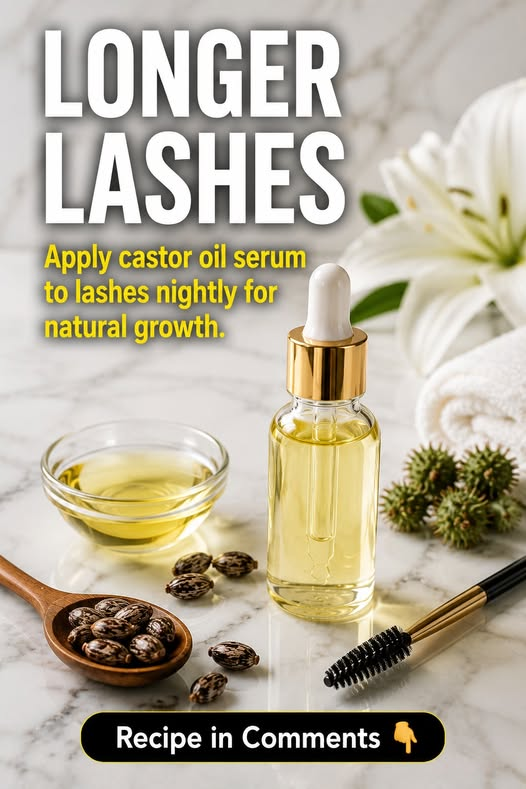
Long, defined eyelashes can make the eyes appear brighter and more expressive, but lashes grow slowly and naturally pass through growth, transition and resting phases. Frequent waterproof mascara, rough makeup removal, lash curlers, extensions, eyelid inflammation and repeated rubbing can cause breakage or premature shedding. A natural serum may condition existing lashes and reduce dryness, but it cannot reliably create dramatic new growth within a few days.
Castor oil is widely promoted for longer lashes, yet clinical research has not proved that pure castor oil increases eyelash length, thickness or follicle number. A comprehensive review graded the evidence supporting castor oil for lash growth as very weak. One controlled trial found that a castor-oil formulation improved signs of blepharitis, but it did not measure new eyelash growth. The only treatment specifically approved by the United States Food and Drug Administration for inadequate eyelashes is prescription bimatoprost. (Wiley Online Library)
The remedies below are therefore designed to condition lashes, reduce breakage and support comfortable eyelid skin. They should not be described as proven growth treatments. Apply only a microscopic amount to the lash hairs, never to the waterline or inside the eye.
Remedy 1: For Normal Skin
Castor, Jojoba and Coconut Lash-Conditioning Serum
Ingredients
- 1 teaspoon cold-pressed castor oil: coats the lashes and may make them look darker, glossier and temporarily thicker.
- 1 teaspoon jojoba oil: provides lightweight lubrication that may reduce friction during cleansing.
- ½ teaspoon virgin coconut oil: has evidence for penetrating hair fibres and reducing protein loss.
- ½ teaspoon argan oil: supplies emollient fatty acids that improve flexibility and shine.
- ½ teaspoon sunflower-seed oil: thins the heavier castor oil and helps the blend spread in a very light film.
Procedure
- Wash and completely dry a small glass container.
- Combine all five oils and mix thoroughly.
- Wash your face and remove mascara and contact lenses.
- Dip a new disposable microbrush into the blend.
- Wipe nearly all visible oil from the brush onto a clean tissue.
- Close one eye and brush the remaining microscopic amount over the middle and tips of the upper lashes.
- Repeat with a new applicator for the other eye.
- Wash the serum off gently the following morning.
Do not use a dropper directly above the eye, coat the lower lashes or brush oil along the wet inner eyelid margin.
Scientific Working of the Ingredients
Coconut oil contains lauric acid, which has a strong affinity for hair protein and can enter the hair shaft. In laboratory research, it reduced protein loss from both damaged and undamaged hair. Although scalp hair and eyelashes are not identical, this supports coconut oil as a conditioning ingredient that may help limit breakage. (PubMed)
Castor, jojoba, argan and sunflower oils mostly coat and lubricate the lash fibre. This may improve shine and flexibility, but no controlled human trial has shown that these oils activate eyelash follicles.
How Often to Apply
Apply on alternate nights for the first five days. When no redness or irritation occurs, continue three nights weekly for eight weeks.
Initial Results
Within one to three days, lashes may appear darker, smoother and more defined because of the light oil coating. Actual lengthening should not be expected during this period.
Remedy 2: For Combination Skin
Green Tea and Aloe Two-Step Lash Routine
Ingredients
- 1 tablespoon cooled green tea: provides antioxidant and anti-inflammatory catechins.
- 1 teaspoon pure aloe vera gel: supplies lightweight hydration to dry eyelid areas.
- ¼ teaspoon colloidal oatmeal: supports an irritated or dehydrated skin barrier.
- 1 teaspoon cooled boiled water: dilutes the preparation for short-contact use.
- 1 drop jojoba oil: conditions only the lash tips without covering oily eyelid areas.
Procedure
- Brew plain green tea and let it cool completely.
- Combine one tablespoon of tea with the aloe, oatmeal and boiled water.
- Dip two clean cotton pads in the mixture and squeeze them well.
- Place the pads over closed eyelids for three minutes.
- Remove them and rinse the eyelids with clean water.
- After the lashes are dry, spread one drop of jojoba oil between two clean disposable microbrushes.
- Brush only the upper-lash tips.
- Discard the tea mixture immediately.
Scientific Working of the Ingredients
This routine treats the eyelid and lash hairs separately. Green tea, aloe and colloidal oatmeal may support comfort and hydration around the eyelids, reducing dryness-related rubbing. Jojoba oil adds light lubrication to the lashes without heavily coating oil-prone eyelid skin.
The routine does not directly stimulate growth. Its realistic purpose is to reduce irritation, rubbing and mechanical damage that may make lashes shed prematurely.
How Often to Apply
Use the closed-lid compress on alternate evenings for five days. Apply the micro-dose of jojoba oil two or three nights weekly.
Initial Results
Dry eyelid areas may feel calmer within one to three applications. The lashes may appear shinier, but measurable growth requires considerably more time.
Remedy 3: For Oily Skin
Oil-Free Green Tea and Cucumber Lash-Line Compress
Ingredients
- 1 tablespoon cooled green tea: provides antioxidant plant compounds.
- 1 tablespoon cooled boiled water: creates a gentle, diluted base.
- 1 teaspoon freshly strained cucumber water: delivers lightweight cooling moisture.
- ½ teaspoon pure aloe vera gel: hydrates without leaving a heavy oil film.
- ¼ teaspoon colloidal oatmeal: helps reduce tightness caused by frequent cleansing.
Procedure
- Prepare the green tea and allow it to cool.
- Mix it with the boiled water and cucumber water.
- Add the aloe and colloidal oatmeal.
- Soak a clean cotton pad and squeeze out excess liquid.
- Keep the eye firmly closed and press the pad over the eyelid for two to three minutes.
- Do not allow liquid to run into the eye.
- Rinse with clean water and pat dry.
- Discard all leftovers.
Scientific Working of the Ingredients
Oily eyelids often feel uncomfortable under heavy lash serums. This oil-free routine supports eyelid cleanliness and hydration without creating a thick coating near the meibomian glands. Green tea and oatmeal may calm mild irritation, while aloe and cucumber provide lightweight moisture.
Healthy eyelid hygiene may help prevent matting and rubbing, but this mixture has not been clinically proven to increase lash length.
How Often to Apply
Use once daily for three days, then three times weekly for up to four weeks.
Initial Results
The eyelids may feel cleaner and less greasy after the first use. Existing lashes can look fresher and more separated, although no new growth should be visible within three days.
Remedy 4: For Dry Skin
Coconut and Argan Protective Lash Serum
Ingredients
- 1 teaspoon virgin coconut oil: helps protect hair protein and reduce fibre damage.
- 1 teaspoon jojoba oil: improves flexibility and reduces friction.
- ½ teaspoon argan oil: conditions brittle, dry-looking lashes.
- ¼ teaspoon castor oil: creates a glossy protective coating.
- ½ teaspoon sunflower-seed oil: lightens the mixture and improves spreadability.
Procedure
- Mix the oils in a thoroughly cleaned and dried container.
- Remove all eye makeup gently.
- Place one drop of the mixture on a clean saucer.
- Touch a disposable microbrush to the drop and wipe off nearly all the serum.
- Close the eye and lightly coat the upper-lash hairs, beginning away from the roots.
- Use a separate applicator for the other eye.
- Leave the light film on for 30 minutes during the first three applications.
- When well tolerated, it may be left on overnight and removed in the morning.
Scientific Working of the Ingredients
Coconut oil offers the strongest hair-fibre evidence in this blend because it can reduce protein loss. The other oils act mainly as emollients, improving slip and reducing the force needed during cleansing. Less rubbing and breakage can help existing lashes remain intact long enough to complete more of their natural growth cycle. (PubMed)
This is still a conditioning treatment, not a clinically proven follicle stimulant.
How Often to Apply
Apply twice during the first five days. Continue two or three nights weekly for eight to twelve weeks.
Initial Results
Dry lashes may feel more flexible and look glossier within one to three days. Reduced breakage is more likely to become noticeable after several weeks.
Remedy 5: For Sensitive Skin
Minimal Oat and Sunflower Closed-Lid Wrap
Ingredients
- 1 tablespoon cooled boiled water: forms a simple fragrance-free base.
- 1 teaspoon colloidal oatmeal: helps soothe dry, reactive skin.
- ½ teaspoon pure aloe vera gel: provides hydration when tolerated.
- 2 drops sunflower-seed oil: supplies a light protective lipid layer.
- 2 drops jojoba oil: conditions the lash tips with minimal heaviness.
Procedure
- Mix the water and oatmeal and leave them for five minutes.
- Add the aloe and stir well.
- Patch-test the mixture beside the outer eye area for 24–48 hours.
- When no reaction develops, apply it to the closed eyelid with a clean cotton pad for two minutes.
- Rinse thoroughly with clean water.
- Mix the sunflower and jojoba oils.
- Use a disposable brush to place an almost invisible amount on the upper-lash tips.
- Stop immediately if itching, swelling, watering or redness occurs.
Scientific Working of the Ingredients
Colloidal oatmeal supports barrier function and can reduce dryness-related discomfort. Aloe may improve surface hydration, while sunflower and jojoba oils provide lubrication. Essential oils, fragrance, lemon juice and homemade herbal extracts are excluded because eyelid dermatitis is commonly triggered by cosmetics, fragrances, preservatives and topical preparations. (PubMed)
How Often to Apply
Use every other night for the first five days. Continue once or twice weekly only when the eye area remains completely comfortable.
Initial Results
Mild dryness may improve within one to three uses. Sensitive eyes should not be expected to tolerate nightly oil application.
Final Tips for Naturally Fuller-Looking Lashes
Remove mascara with gentle downward strokes instead of pulling lashes sideways. Never sleep in mascara, and replace eye makeup regularly. One study linked improper waterproof-mascara removal with increased eyelash loss. (PubMed)
Limit lash extensions, frequent curling and heavy false lashes. Extensions and adhesives have been associated with allergic eyelid inflammation, tear-film disruption, corneal irritation and traction-related lash loss. (PubMed)
Never add rosemary, peppermint, tea tree, lavender or other essential oils to a homemade lash serum. Do not use onion juice, lemon, garlic, turmeric or powdered herbs around the eyes. Natural substances can still cause eyelid dermatitis or ocular injury.
Conditioning may improve shine and flexibility within two to three days. Reduced breakage may take four to eight weeks, while visible growth normally requires at least two to four months. Even prescription bimatoprost has a gradual effect that is usually not significant for most patients until approximately two months. It can also cause itching, redness, eyelid darkening and potentially permanent brown iris pigmentation, so it should be discussed with a qualified clinician. (FDA Access Data)
Diet Plan to Support Healthy Lash Growth
Breakfast
Eat eggs, plain yogurt, lentils, chickpeas or tofu with whole fruit. These foods provide protein and micronutrients needed for normal hair production.
Lunch
Choose fish, chicken, beans or lentils with leafy vegetables and whole grains. Include a vitamin-C-rich food alongside plant sources of iron.
Snack
Select pumpkin seeds, walnuts, almonds, roasted chickpeas or plain yogurt instead of relying on unproven lash-growth gummies.
Dinner
Include protein, colourful vegetables and unsaturated fats from fish, avocado, nuts or seeds.
Supplement Guidance
Do not begin high-dose biotin solely for longer lashes. Biotin deficiency can contribute to hair problems, but deficiency is uncommon in people eating a balanced diet. Large supplemental doses can interfere with laboratory tests, including certain hormone and cardiac tests. (Office of Dietary Supplements)
Follow the diet plan for at least eight to twelve weeks and use only one suitable conditioning routine. Consult a dermatologist or eye doctor if lash loss continues longer than four to six weeks, develops suddenly, affects only one eye or occurs with itching, crusting, swelling, scalp hair loss or eyebrow loss. Thyroid disorders, blepharitis, alopecia areata, infections and other conditions can cause eyelash loss and need appropriate diagnosis. (PMC)
References for the above remedy
- U.S. Food and Drug Administration. LATISSE Bimatoprost Ophthalmic Solution Prescribing Information.
https://www.accessdata.fda.gov/drugsatfda_docs/label/2021/022369s014lbl.pdf - Baiyasi-Koz E, et al. Eyelash Serums: A Comprehensive Review.
https://onlinelibrary.wiley.com/doi/10.1111/jocd.16278 - Muntz A, et al. Randomized Trial of Topical Periocular Castor Oil Treatment for Blepharitis.
https://pubmed.ncbi.nlm.nih.gov/32422285/ - Rele AS, Mohile RB. Effect of Mineral Oil, Sunflower Oil and Coconut Oil on Prevention of Hair Damage.
https://pubmed.ncbi.nlm.nih.gov/12715094/ - Glaser DA, et al. Long-Term Safety and Efficacy of Bimatoprost Solution for Eyelash Hypotrichosis.
https://pubmed.ncbi.nlm.nih.gov/25296533/ - Sullivan DA, et al. TFOS Lifestyle: Impact of Cosmetics on the Ocular Surface.
https://pubmed.ncbi.nlm.nih.gov/37061220/ - Amano Y, et al. The Effects of Eyelash Extensions on the Ocular Surface.
https://pubmed.ncbi.nlm.nih.gov/38171996/ - Vij A, et al. Mascara-Induced Milphosis: An Etiological Evaluation.
https://pubmed.ncbi.nlm.nih.gov/24574694/ - American Academy of Dermatology. Hair Loss: Causes.
https://www.aad.org/public/diseases/hair-loss/causes/18-causes - National Institutes of Health, Office of Dietary Supplements. Biotin: Health Professional Fact Sheet.
https://ods.od.nih.gov/factsheets/Biotin-HealthProfessional/